How AI Overviews transform Google visibility in Morocco. Analysis, scientific evidence, and a practical 4-stage framework for Generative Engine Optimization.
Abstract
Recent data and clickstream analyses demonstrate a fundamental shift in search behavior. As generative AI integrates directly into Google search results via AI Overviews and the forthcoming AI Mode, traditional click-based journeys are eroding. Direct observation of CoreMedia's Search Console data in Morocco reveals zero-click patterns for major commercial queries, mirroring industry findings (SparkToro, 2025; Seer Interactive, 2025). For Moroccan service businesses relying on organic search, the potential visibility loss is critical. This article explores the evidence behind generative answer engines' impact on organic CTR (Zhao et al., 2025) and provides a four-stage strategic framework: auditing, answer-first content creation, structured data optimization, and combined measurement. It is time to optimize for generative answer engines.
Selected clients, published with permission. More references will be added after approval.
1. The Search Console Signal That Started This Investigation
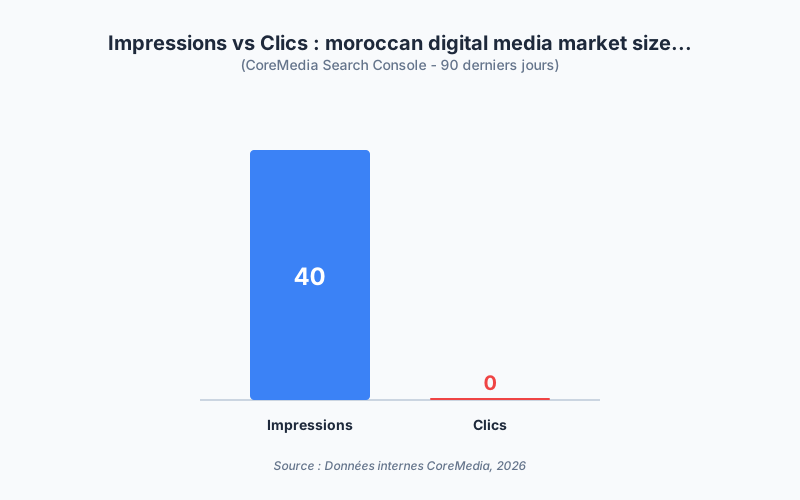
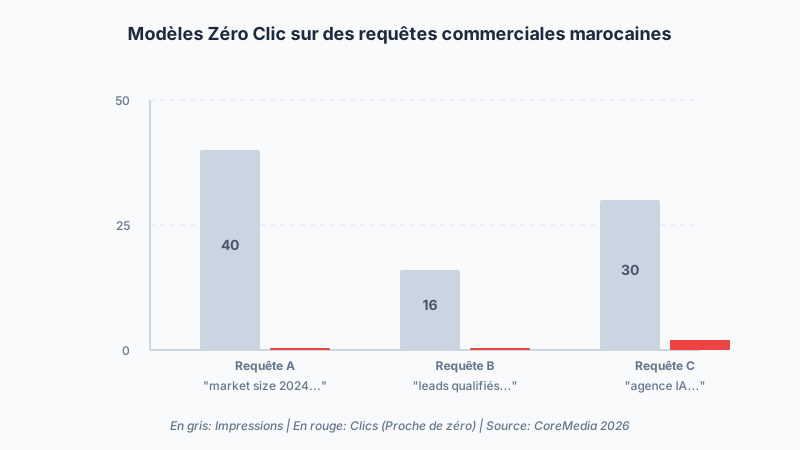
It all started with a statistical anomaly in our own data. While analyzing the CoreMedia Search Console over the last 90 days, we isolated an increasingly frequent behavioral pattern in the Moroccan market. For the strategic commercial query "moroccan digital media market size 2024 2025 advertising revenue", our agency page ranked at an average position of 10.65. It generated 40 impressions. Yet, the number of clicks was exactly zero (CoreMedia, 2026). Getting impressions without a single click on a query with high commercial intent is no longer an isolated anomaly; it is the symptom of a zero-click SERP.
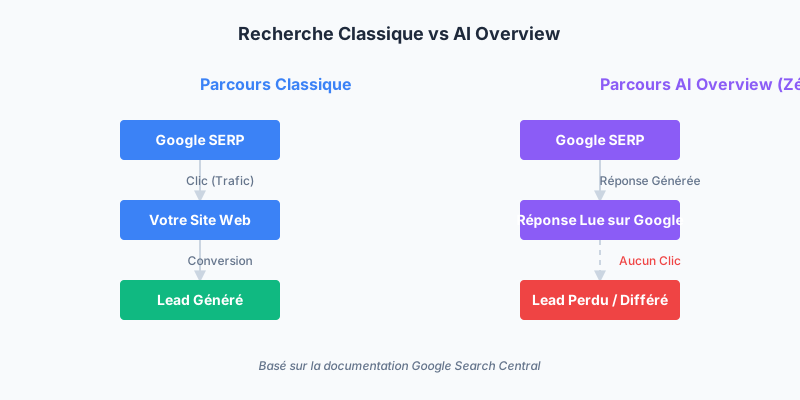
A zero-click SERP occurs when the user's intent is fully satisfied directly on the search results page, negating the need to visit an external website. While zero-click searches have been rising according to multiple clickstream panel studies (SparkToro, 2025; Seer Interactive, 2025), the introduction of AI Overviews accelerates this trend dramatically. AI Overviews often satisfy search intent by synthesizing the answer directly in the SERP, fundamentally changing the classic conversion path (Zhao et al., 2025). For any Moroccan digital service business, or anySEO agency Moroccoranking clients on Google's first page, this is a glaring warning sign: merely ranking no longer guarantees organic traffic.
Figure 1: CoreMedia Search Console data shows 40 impressions and zero clicks for a commercial research query over the last 90 days, a live example of a zero-click SERP. (Source: Internal CoreMedia Data, 2026).
2. What AI Overviews Actually Are, And What They Are Not
Before drastically altering an acquisition strategy, defining the technology accurately is crucial. An AI Overview is not simply a larger featured snippet. It is a dynamic summary generated by a Large Language Model (LLM) that appears at the top of Google search results to answer complex queries directly. According to official documentation (Google Search Central, n.d.), these overviews are designed to help users find information faster by compiling data from multiple web sources into a single synthetic paragraph.
Google has pushed this concept further with the recent announcement of 'AI Mode', an opt-in search experience that transforms the traditional search engine into a true multi-source answer engine (Google, 2026). Simultaneously, generative engines like ChatGPT, Perplexity, and Claude are redefining how professionals search for information. Unlike Classic Google, which provides paths (links) to answers, these generative answer engines provide the destination itself. They synthesize recommendations without requiring a traditional click path (BrightEdge, 2025). This means the SEO paradigm is shifting from acquiring clicks to acquiring citations within these synthesized answers.
Figure 2: Classic search funnels clicks to websites; AI Overviews increasingly deliver the answer directly on the SERP, reducing click-through. (Source: Editorial diagram based on Google Search Central, n.d.).
3. The Zero-Click Evidence: What We Actually Know
The exact impact of AI Overviews is intensely debated, but emerging data outlines a clear trend. It is necessary to distinguish peer-reviewed empirical research from industry panel data.
3.1 The Preprint Evidence on AI Overviews and CTR
A recent preprint (Zhao et al., 2025) emphasizes that queries triggering AI Overviews tend to reduce organic Click-Through Rate (CTR) for results positioned below the overview. The magnitude of this effect varies significantly depending on the query type, industry, and user intent. Although this is a directional empirical finding rather than a universal law, it confirms that the interface modifies the attention economy on the page.
3.2 Industry Panel Data on Zero-Click Search
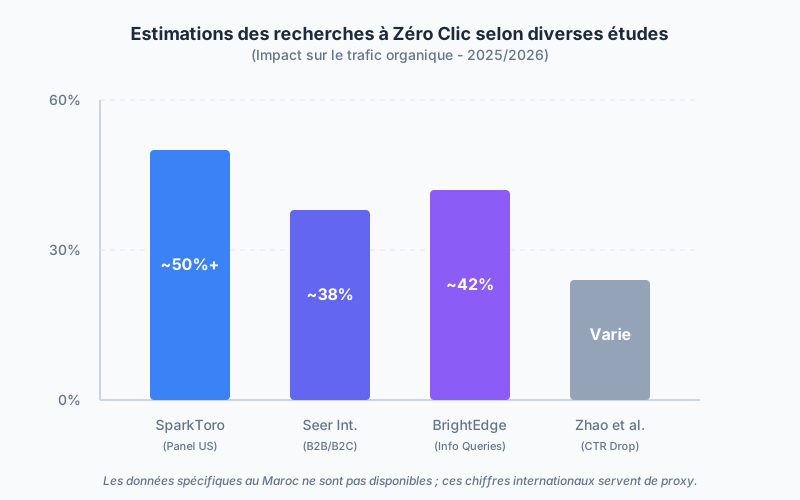
The SEO industry relies heavily on user panel analytics. Studies by SparkToro (2025) and Seer Interactive (2025) estimate that the share of searches ending without a click has expanded considerably, settling in a majority range for informational queries. BrightEdge's (2025) research confirms this heterogeneity: Generative Engine Optimization (GEO) has become imperative because the impact varies massively between purely informational queries and high-value commercial queries.
3.3 What the Evidence Does Not Tell Us, Especially for Morocco
Rigor is vital here: there is no specific study on zero-click search percentages for Morocco. We cannot categorically claim that a fixed proportion of Moroccan searches ends without a click. International figures serve as a robust proxy, but Moroccan businesses must extrapolate these trends cautiously, based on their own unexplained CTR declines.
Figure 3: Reported estimates vary by methodology. Figure presents published ranges from each source; Morocco-specific data is not available. (Sources: Zhao et al., 2025; SparkToro, 2025; Seer Interactive, 2025; BrightEdge, 2025).
4. Generative Engines Are the Next Layer
The transformation does not stop at Google's results. Generative answer engines (ChatGPT, Perplexity, Claude, and Google AI Mode) are rapidly establishing themselves as primary research tools, particularly for B2B tasks. A recent survey highlights that generative engine usage for research tasks is increasing steadily among B2B buyers (HubSpot Research, 2025). These engines answer questions by synthesizing service provider recommendations from existing web content, directories, and user reviews.
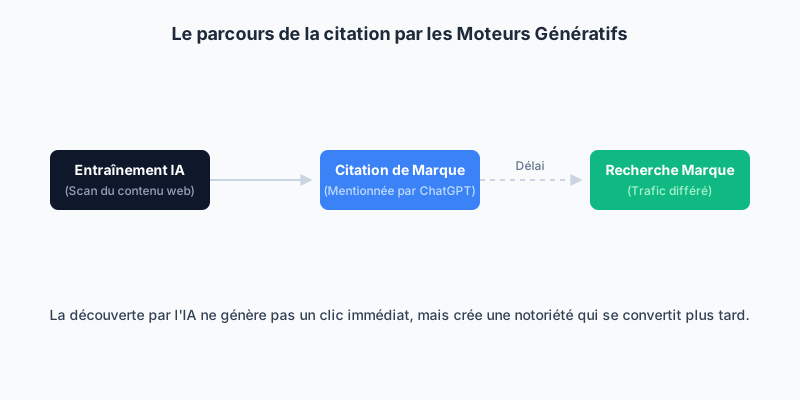
The paradigm shift is profound: being cited by a generative engine does not necessarily generate a click (BrightEdge, 2025). The AI reads your website, extracts your company's value proposition, and presents it to the end user as plain text. The direct transactional relationship between content creation and traffic acquisition is broken. The user discovers your brand through AI, but this discovery often results in a brand mention without an immediate site visit. This behavior defers the site visit to a later stage of the buyer's journey, via a downstream branded search.
Figure 4: Being cited in a generative answer does not guarantee a click; value accrues through downstream branded searches and deferred visits. (Source: Editorial diagram based on BrightEdge, 2025).
5. Why This Matters More for Moroccan Service Businesses
The Moroccan digital ecosystem exhibits characteristics that make this transition particularly delicate. Moroccan digital adoption and internet infrastructure are consistent with regional MENA trends (World Bank, 2025), and general North African search behavior patterns reflect similar commercial query structures to other emerging markets (Hernández, 2025). This means Moroccan professionals use Google exactly like their international counterparts to find B2B service providers.
However, many Moroccan service businesses, consultants, and agencies depend almost exclusively on Google organic traffic for lead generation. Highly competitive queries like "leads qualifiés maroc" already show visibility patterns without engagement. According to our Search Console analysis (CoreMedia, 2026), a page ranked 18th for this specific commercial query generated 6 impressions and zero clicks. When generative engines intercept the commercial investigation phase, a Moroccan business not optimized for AI citations risks total invisibility. For instance, if a marketing director asks ChatGPT to recommend an "AI agency Morocco", the tool will synthesize its answer from the best-structured entities (similar to automation players like Majjane, 2026, observed in the Moroccan competitive landscape). Not appearing in this generated answer is equivalent to losing the lead before they even visit a website.
Figure 5: Multiple commercial Moroccan queries show zero-click patterns in CoreMedia Search Console, indicating broader visibility without engagement. (Source: CoreMedia, 2026, internal data).
6. The Answer-First Framework: Four Stages for Moroccan Businesses
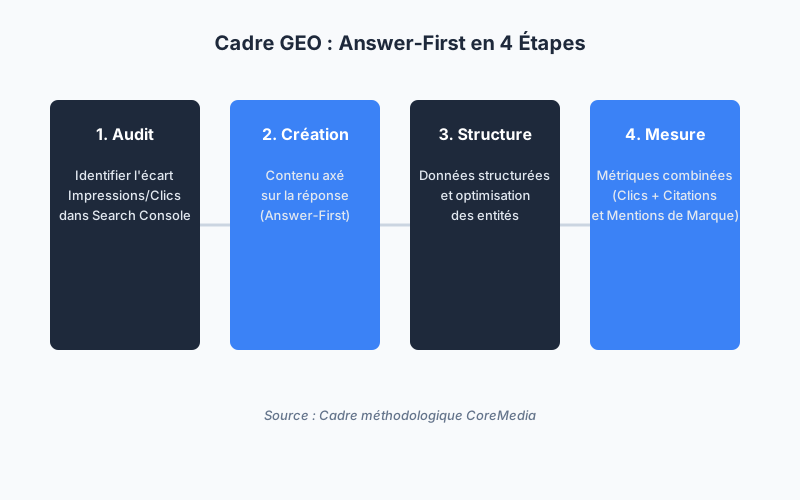
How can one survive and thrive in this new environment? CoreMedia proposes a practical, four-stage Generative Engine Optimization (GEO) framework tailored for Moroccan businesses. The goal is to ensure yourintelligent automation solutionsand services are systematically sourced by LLMs.
Stage 1: Exposure Audit. Identify which of your key commercial queries are already triggering AI Overviews. Monitor the growing gap between your impressions and clicks in the Search Console.
Stage 2: Answer-First Content Building. Generative engines favor information density. Long, diluted texts lose out to structured formats with clear, concise, and factual Q&A, thereby increasing the probability of citation (BrightEdge, 2025; Zhao et al., 2025).
Stage 3: Entity Structuring. Sprinkling keywords is no longer enough. You must integrate rigorous Schema.org markup to define your business as an entity, ensuring perfect consistency of your information across all relevant directories and review sites.
Stage 4: Multidimensional Measurement. Transition from an analytics model focused solely on clicks to a combined model that includes brand mentions and downstream searches.
Figure 6: A four-stage framework: audit current AI Overview exposure, build answer-first content, implement structured data and entity optimization, and measure clicks plus citations. (Source: Editorial diagram based on Google Search Central, n.d.; BrightEdge, 2025; Schema.org, n.d.).
7. Structured Data, Entities, and Getting Cited in Generative Answers
For AI to find you, you must speak its language. That language is not commercial French or English, but structured data.
7.1 Structured Data: The Technical Layer
Structured data enables LLMs to extract facts deterministically. Optimized presence via Schema.org markup, with clear entity definitions, significantly improves the likelihood of being cited in AI-generated answers (Google Search Central, n.d.; Schema.org, n.d.). Moroccan businesses must imperatively implement Organization, LocalBusiness, Service, FAQPage, and Review schemas so their services are intelligible to Google's bots.
7.2 Entity Optimization: The Semantic Layer
Traditional SEO focused on keywords. Generative Engine Optimization focuses on entities (BrightEdge, 2025). Your business must become a recognized semantic entity. This requires consistent semantics, establishing strong thematic relationships on your site, and eliminating ambiguities around your brand.
7.3 Directories and Reviews: The Trust Layer
Generative AIs do not invent trust; they aggregate it. They rely heavily on external authority signals (BrightEdge, 2025). For a service business in Morocco, being present with consistent data on reliable professional directories and accumulating verified positive reviews are absolute prerequisites to hope for a recommendation by ChatGPT or AI Mode.
8. Measurement and ROI: From Clicks to Citations to Revenue
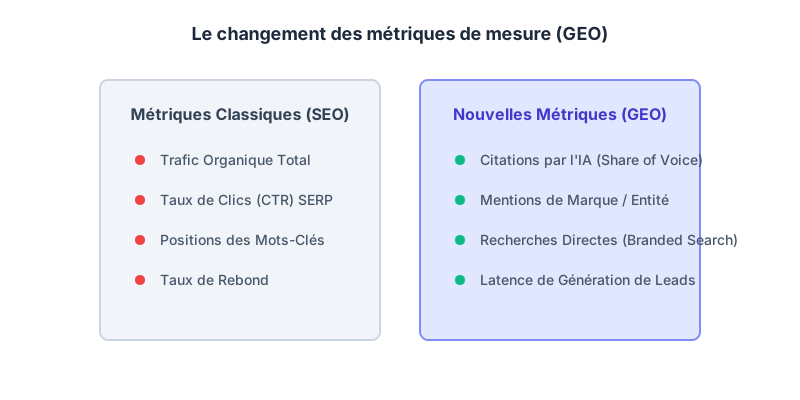
If the organic click disappears, how do you prove the ROI of your content marketing? The answer lies in revamping your KPIs. Moroccan businesses should supplement traditional click-only performance indicators with metrics related to AI citations and downstream brand mentions (BrightEdge, 2025; HubSpot Research, 2025). The study by Zhao et al. (2025) also highlights the need to adjust CTR measurement methods in light of these new paradigms.
Practically, this involves tracking the increase in branded searches in the Search Console, as a user reading your name in an AI Overview will often perform a direct search for your brand the next day. It is also necessary to analyze the lag between citation andqualified lead generation, because the buyer's journey technically lengthens in terms of follow-up touchpoints. A modern AI agency Morocco integrates this latency into its financial reporting.
Figure 7: Moroccan businesses should supplement click-only KPIs with AI citation and downstream brand metrics. (Source: Editorial diagram based on BrightEdge, 2025; HubSpot Research, 2025).
9. Risks, Governance, and What Could Go Wrong
Diving headlong into extreme Generative Engine Optimization carries risks. The first pitfall is manipulation. Google's documentation (Google Search Central, n.d.) warns against manipulative AI optimization practices. Overloading a site with fake structured data will result in severe algorithmic penalties.
Furthermore, the infrastructure of these AI models evolves very rapidly. An optimization that works today might be obsolete tomorrow. The instability of AI Overviews, whose appearance rate fluctuates daily, demands prudent governance. Finally, one limitation of current evidence is that AI Overview adoption in Morocco could follow a slower curve than in North American markets. If Moroccan businesses completely abandon classic SEO too early, they risk losing existing residual traffic. The limitations of current research (Zhao et al., 2025) remind us that the transition to zero-click search is a spectrum, not an instant switch.
10. Conclusion and What Moroccan Businesses Should Do Next
The transformation of Google visibility is underway. Industry data (BrightEdge, 2025), preliminary academic research (Zhao et al., 2025), and our own observations in the Search Console (CoreMedia, 2026) converge on a single reality: search is becoming a zero-click answer engine, and visibility now requires Generative Engine Optimization.
For leaders of Moroccan service businesses, the time to act is now. Do not remain passive while AI Overviews redefine digital market shares. Immediate application of our four-stage framework, audit, answer-first content, entity structuring, and new measurement, will allow you to maintain and expand your digital footprint.