AI is reshaping the travel booking journey. Learn how Moroccan tourism businesses can stay visible when AI agents are choosing for travelers. Evidence and practical framework.
Abstract
Artificial intelligence is not just making internal processes more efficient; it has fundamentally altered how strategies are designed by mediating between businesses and their customers. This paradigm shift, documented by Harvard University and the IMF in July 2026, is critical for tourism. Your customers now research, compare, and choose their suppliers using AI agents. This article analyzes the scientific evidence of this transition to a 'mediated' purchase journey, maps the exposure of different Moroccan tourism segments (from medina riads to business hotels), and presents the 5-pillar CoreMedia framework to ensure an AI consulting Morocco agency can translate your authentic hospitality into machine-readable data.
Selected clients, published with permission. More references will be added after approval.
1. Introduction: The Traveler Is No Longer Who You Think
The Moroccan tourism sector has historically relied on the human experience. From the mint tea served upon arrival in a riad to the concierge's personalized recommendations, authenticity has been the primary driver of customer acquisition. However, a major strategic upheaval, often invisible to hoteliers, is occurring: the booking decision-maker is no longer exclusively human.
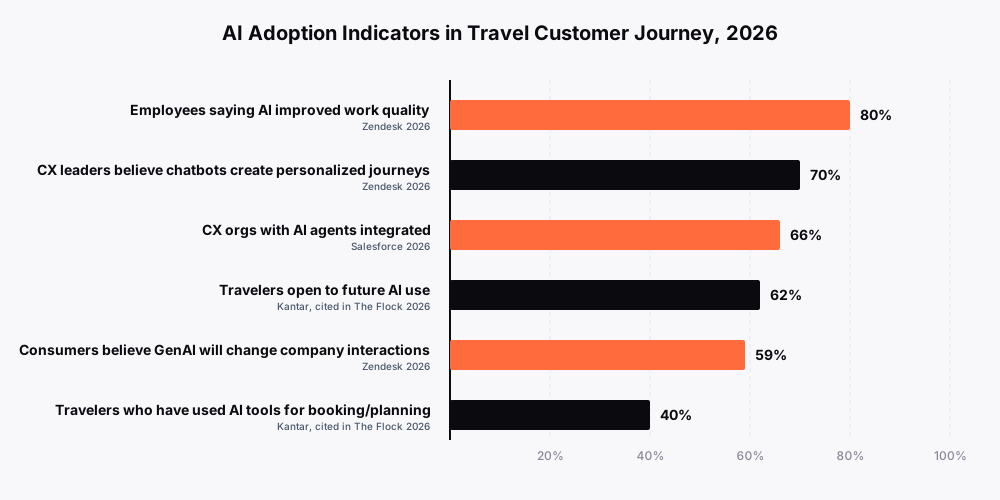
As researchers at Harvard Business School point out, 'AI has not just helped firms co-create strategy with customers more efficiently, it has changed how strategy is designed. Your customers now research, compare, and choose suppliers using AI agents' (Kenny and Pogrebna, 2026). A recent survey reveals that 59% of consumers believe generative AI will fundamentally change how they interact with companies in the next two years (Zendesk, 2026). AI visibility Morocco tourism is no longer a futuristic concept; it is an immediate imperative to survive in a market where the algorithm pre-selects the destination before the traveler even intervenes.
2. How AI Becomes the Invisible Travel Intermediary
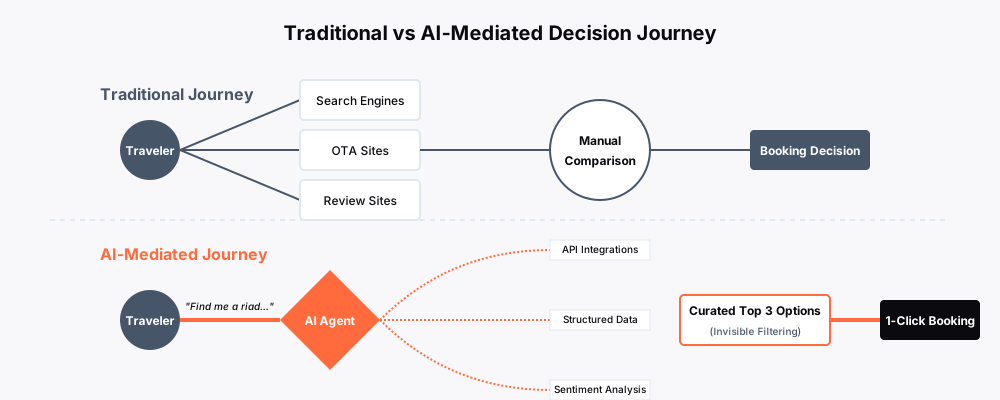
To understand the scale of this change, we must dissect the AI customer journey Morocco hospitality. Traditionally, a tourist planning a trip to Marrakech navigated between Google, Booking.com, and TripAdvisor. Each interaction left a trace, and the prospect remained exposed to the hotel's direct visual marketing. Today, this model is being replaced by 'algorithmic mediation'.
In this new paradigm, the customer interacts with an advanced conversational agent. They formulate a complex AI travel booking Morocco query (e.g., 'Find me a quiet riad in the Fez medina, suitable for couples, with excellent Wi-Fi connectivity and a budget under 150 euros'). The AI agent performs the invisible sorting, queries APIs, analyzes thousands of reviews to extract sentiment, and presents only three highly qualified options to the customer. Businesses that are not structured to be read by these algorithms literally become invisible (Kenny and Pogrebna, 2026). As industry experts indicate, around 40% of travelers have already used AI-driven tools during booking or trip planning, and 62% of travelers are open to using AI in the future (Kantar, cited in The Flock, 2026). Customer acquisition costs continue rising while AI investment is high, making mastery of these new channels essential (TSIA, 2026).
Figure 1: Comparison of the traditional travel booking journey and the AI-mediated journey. In the mediated journey, the AI agent filters, compares, and pre-selects before the traveler intervenes. Source: CoreMedia, adapted from Kenny and Pogrebna (2026).
3. What the Numbers Say: 2026 Evidence and Trends
Consumer and customer service adoption of AI crossed a point of no return in 2026. On the operations side, the International Monetary Fund reports that 'an AI assistant in a customer-service call center raised productivity by 15% on average, with the largest gains among less experienced and lower-skilled workers' (IMF, 2026, referencing Brynjolfsson et al., 2025). This operational efficiency translates directly into a restructuring of customer relations.
On the side of Customer Experience (CX) leaders, the trend is even more pronounced. 70% of CX leaders believe chatbots are becoming skilled architects of highly personalized customer journeys (Zendesk, 2026). More impressively, 70% of customer service organizations report that AI agents are now embedded in their workflows, up from 39% in 2025 (Salesforce, 2026). And for good reason: AI-powered personalization can boost customer satisfaction by up to 20% (McKinsey, cited in The Flock, 2026).
It is important to emphasize that this data comes from international panels, which constitutes a gap in specific Moroccan academic research. However, knowing that the majority of international tourists visiting Morocco come from these same mature markets, their behavior dictates the new norm.
Figure 2: Key AI adoption indicators in customer experience and travel, 2026. Data from international surveys; Moroccan equivalents are not yet available.
4. Why Morocco's Tourism Sector Is Particularly Exposed
The digital transformation Morocco tourism 2026 transition is underway, but it faces unique challenges. Research shows that digital transformation significantly improves hotel efficiency, guest satisfaction, and competitiveness (ResearchGate, 2026). However, Moroccan tourism is characterized by a dichotomy: on the one hand, large resort complexes equipped with robust Property Management Systems (PMS); on the other, thousands of guesthouses and riads whose strength lies in extreme human personalization.
This model of high human intermediation is particularly vulnerable to algorithms that favor structured data and real-time availability. If a riad has an exceptional reputation but lacks correct schema markup or fast API connectivity, it will simply be ignored by an AI travel agent. Literature indicates that automating routine tasks, reservations, financial reconciliations, guest communications, frees human staff for higher-value interactions (SAGE Journals, 2025), but this requires a digital maturity that many Moroccan operators have yet to achieve.
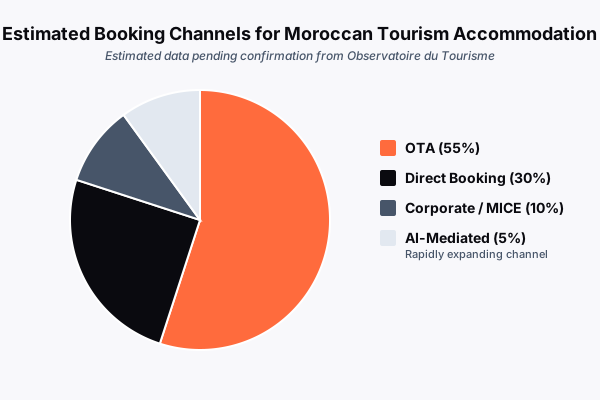
Figure 3: Estimated distribution of booking channels for Moroccan tourism accommodation. Data to be confirmed with the Observatoire du Tourisme. [Note: indicative data.]
5. The Four Segments of Moroccan Tourism Facing AI
Exposure to this algorithmic mediation is not uniform. A granular analysis of the AI-powered guest experience Morocco requires segmenting the national offering according to its degree of vulnerability and readiness.
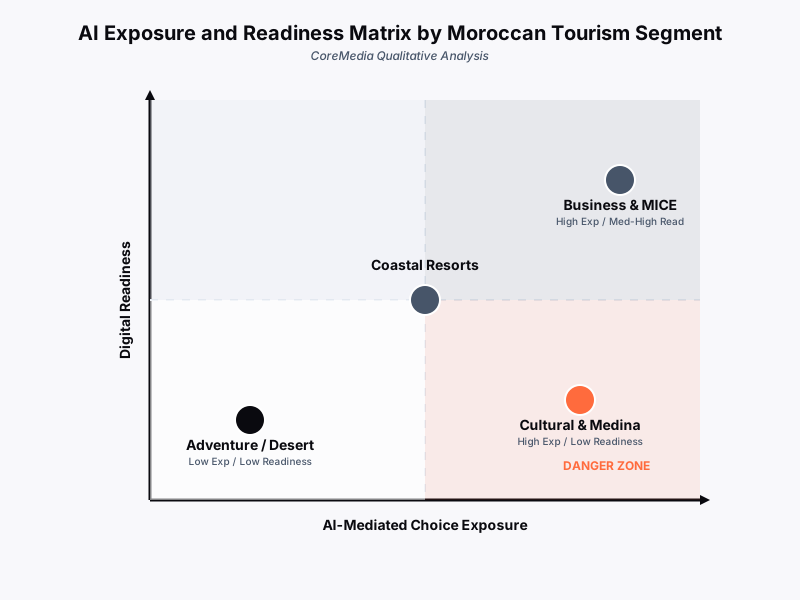
Cultural tourism and medinas (Fez, Marrakech) face very high exposure. Their international clients massively use LLM-based planning tools to navigate accommodation offerings often perceived as fragmented and complex. However, this segment often displays low digital readiness. Coastal resorts (Agadir, Taghazout), heavily intermediated by large tour operators, benefit from medium readiness and indirect exposure. Business and MICE tourism (Casablanca, Rabat) demands immediate technological integration; corporate AI assistants are already organizing entire trips. Finally, adventure tourism (Dakhla, Merzouga) remains relatively sheltered in the short term due to heavy reliance on human expertise, although the gap is closing (Pitakaso et al., 2025).
Figure 4: Positioning of four Moroccan tourism segments by AI-mediated journey exposure and digital readiness. CoreMedia qualitative analysis.
6. Practical Framework: The Five Pillars of AI Visibility for Moroccan Hospitality
Faced with this paradigm shift, how can a tourism business survive and thrive? As a leading agency, CoreMedia has developed a strategic tourism automation Morocco framework structured around five essential pillars to guarantee machine discoverability (Kenny and Pogrebna, 2026).
Pillar 1: Structured Data and Schema Markup
The first pillar involves translating your offering into a language algorithms understand. Using Schema.org markup (notably `LodgingBusiness`, `HotelRoom`, `Offer`) is non-negotiable. An LLM will not read an aesthetic PDF; it will scan your site's code to extract exact rates, cancellation policies, and amenities.
Pillar 2: Multilingual Content Strategy
AI agents compare semantics. If your site only offers a brief description, the agent cannot recommend your establishment against a complex query. Content must be rich, factual, and perfectly translated, as travel AIs operate simultaneously in dozens of languages.
Pillar 3: Review Ecosystem and Sentiment
Algorithmic visibility relies heavily on social sentiment. AI agents synthesize thousands of Google, TripAdvisor, and Booking reviews in seconds. A proactive strategy for collecting and managing review responses is critical, as the algorithm detects signals of systemic satisfaction or dissatisfaction.
Pillar 4: API Connectivity and Availability
An AI agent will not email you to check availability. It relies on real-time XML feeds and JSON APIs. Seamless integration with modern channel managers is essential. If your inventory cannot be queried instantly, the AI will move to the next supplier.
Pillar 5: AI Monitoring and Optimization
Optimization is not a one-time event. It involves continuously monitoring how AI search engines (like Perplexity or Search Generative Experience) position your establishment (TSIA, 2026), and adjusting metadata based on these new ranking algorithms.
Figure 5: CoreMedia five-pillar framework for AI visibility for Moroccan tourism businesses. Each pillar is necessary; the absence of any one compromises overall visibility.
7. Concrete Cases: Scenarios for a Riad, a Tour Operator, a Hotel
To materialize this framework, let's apply it to three typical profiles within the national tourism ecosystem (ResearchGate, 2026; SAGE Journals, 2025).
Scenario 1: A Family Riad in the Fez Medina
A traditional 8-room riad risks losing its direct bookings if its website remains a static storefront. By deploying Pillar 1, the riad integrates detailed schema markup specifying its exact location (proximity to Bab Boujloud), authentic architecture, and dining services. Pillar 3 is activated through an automated post-stay review campaign via WhatsApp, generating semantic volume that AIs can extract to qualify the riad's hospitality.
Scenario 2: A Desert Adventure Tour Operator
This operator, specializing in luxury bivouacs in Merzouga, activates Pillars 2 and 4. Its tent inventory is connected via API to a distribution platform, and its content technically details its excursions (GPS, difficulty, equipment). When an AI agent receives a query for 'eco-responsible Sahara experience with comfort', the factual metadata propels the tour operator to the top of algorithmic recommendations.
Scenario 3: A Mid-Scale Hotel in Marrakech
Facing fierce competition, this hotel deploys the full framework. It uses sentiment analysis (Pillar 3) to identify that AI-mediated clients are specifically searching for remote work capabilities. It adjusts its markup (Pillar 1) to highlight 'guaranteed high-speed Wi-Fi' and implements daily tracking (Pillar 5) to ensure LLMs integrate this new value proposition.
8. Risks, Limitations, and Pitfalls to Avoid
It is essential to maintain a critical perspective on automation. One study notes that AI-powered customer service fails at four times the rate of other tasks, sometimes creating severe frustration (Qualtrics, 2025). The major risk of algorithmic over-optimization is losing the soul of the Moroccan tourism product.
Furthermore, this analysis encounters factual limitations. We do not have verified Moroccan statistics on the exact adoption rate of these tools by hospitality SMEs. Figure 3 relies on industry estimates (The Flock, 2026). Finally, compliance is essential. Using AI tools to interact with European travelers requires compliance with the European GDPR (ICLG, 2026) as well as Moroccan Law 09-08 governing personal data protection.
9. Measuring Return: Indicators and Dashboard
Algorithmic visibility is not measured by simple website visits. Establishments must pivot to new key performance indicators (KPIs) (TSIA, 2026; Zendesk, 2026).
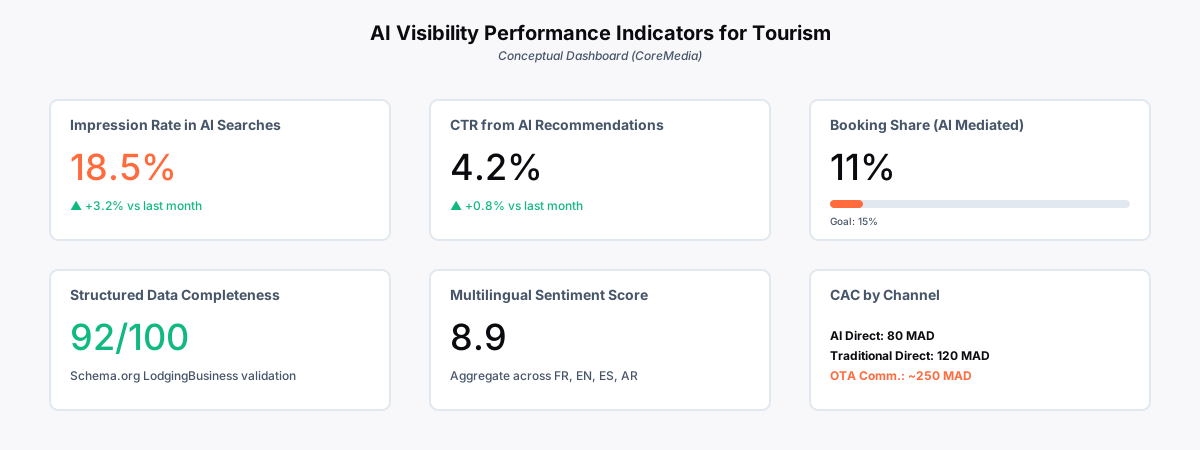
Critical metrics now include 'impression rate in AI searches', click-through rate from algorithmic recommendations, and above all, the structured data completeness score. Establishing a baseline customer acquisition cost (CAC) per channel allows businesses to mathematically prove the impact of LLM optimization versus traditional OTA commissions.
Figure 6: Proposed key performance indicators for measuring the AI visibility of a Moroccan tourism business. CoreMedia conceptual dashboard.
10. 2026-2030: Morocco's Strategic Window
Morocco is preparing for decisive milestones. According to forecasts, the number of international tourist arrivals is expected to grow massively as we approach the 2030 decade (Statista, 2026). The co-hosting of the 2030 FIFA World Cup acts as an unprecedented accelerator for the Morocco tourism AI strategy.
This four-year window of opportunity is precisely when the Moroccan hospitality infrastructure must complete its digital transformation. The millions of fans flocking from Europe and the Americas in 2030 will natively use AI agents to organize their travel from Casablanca to Agadir. Failing to invest in AI optimization today guarantees a severe loss of market share tomorrow.
11. Conclusion: Authenticity Must Become Machine-Readable
The customer journey in Moroccan hospitality has irreversibly changed. AI agents filter, qualify, and choose on behalf of the traveler. For Moroccan tourism businesses, the historical competitive advantage based on hospitality, cultural richness, and interpersonal relationships remains powerful, but it is under threat.
This authenticity is useless if it is not translated into a format that is readable, indexable, and prioritizable by AI recommendation engines. The first-mover advantage window is open, but it is closing rapidly. The transition to an AI visibility Morocco tourism model that respects the DNA of national tourism is the challenge of the end of this decade.
ICLG (2026) 'France - Data Protection Laws and Regulations 2026'. Available at: View source ↗
IMF (2026) 'Aggregate Gains from AI and Their Distribution', IMF Working Paper 2026/147, 10 July. Available at: View source ↗
Kenny, G. and Pogrebna, G. (2026) 'AI Is Changing How Customers Choose Your Business', Harvard Business Review, 6 July. Available at: View source ↗
Pitakaso, R. et al. (2025) 'Embracing open innovation in hospitality management', ScienceDirect. Available at: View source ↗
Qualtrics (2025) 'AI-Powered Customer Service Fails at Four Times the Rate of Other Tasks', 7 October. Available at: View source ↗
ResearchGate (2026) 'Digital Transformation in the Hospitality Industry: Improving Efficiency and Guest Experience', 12 July. Available at: View source ↗
SAGE Journals (2025) 'Investigating the Impact of Automation, Digital Worker, and AI in Hospitality', 23 July. Available at: View source ↗
Salesforce (2026) 'AI Service Agents Improve Customer Satisfaction', 20 May. Available at: View source ↗
Statista (2026) 'Number of international tourist departures Morocco 2050', 14 July. Available at: View source ↗
The Flock (2026) 'AI in Travel 2026: Benefits for the Travel Industry & Tourism', 8 July. Available at: View source ↗
TSIA (2026) 'The State of Customer Success 2026: Proving Value in the Age of AI Economics', 11 February. Available at: View source ↗
Zendesk (2026) '59 AI customer service statistics for 2026', Zendesk Blog, 12 January. Available at: View source ↗