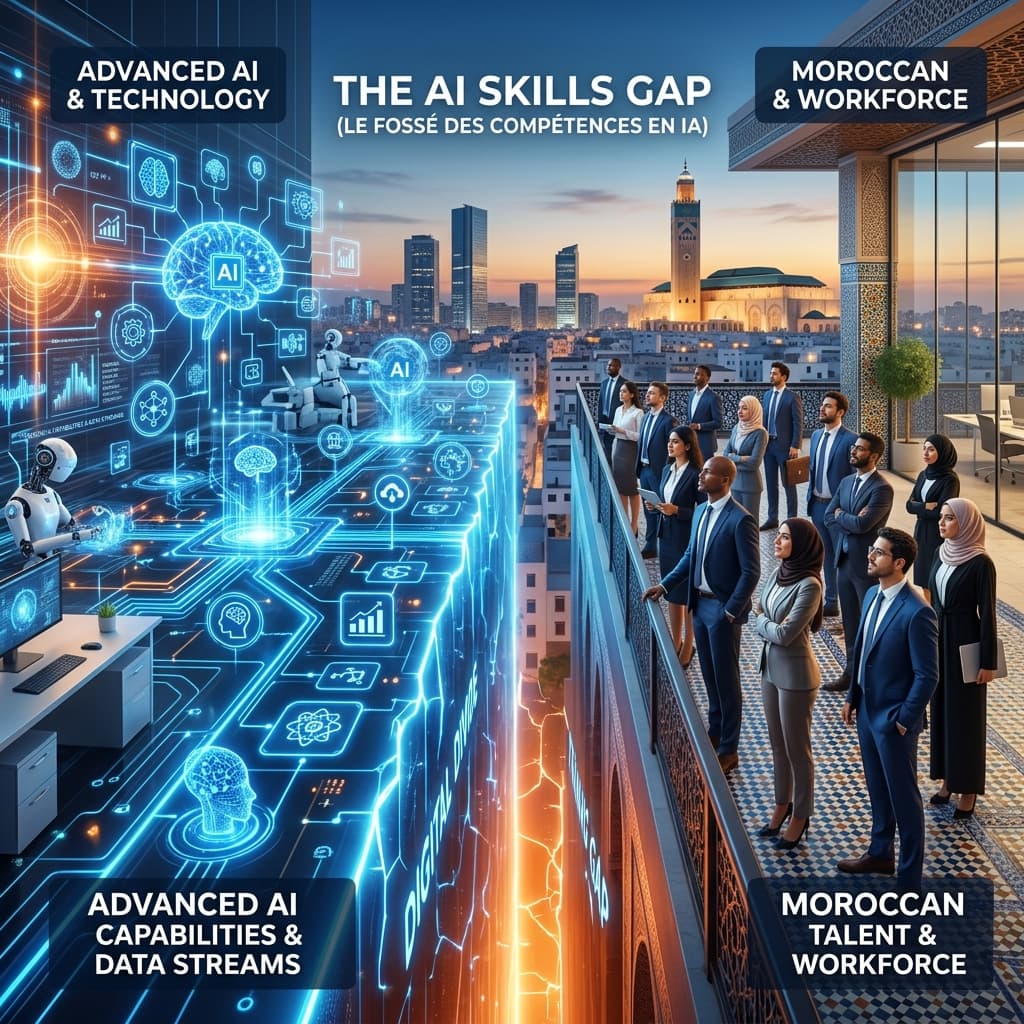
The artificial intelligence debate has long been dominated by Silicon Valley perspectives focused entirely on Western economies. However, the release of the World Development Report 2026: The Promise of Artificial Intelligence (World Bank, 2026) marks a historic institutional turning point. The World Development Report (WDR), published annually by the World Bank, is considered the gold standard of development economics research. Its rigorous peer-review process and global reach make it a foundational document, and the 2026 edition represents the first comprehensive assessment of AI's implications specifically for developing nations.
Why does this report alter the conversation? Until now, AI integration in markets like Morocco was frequently framed through the exclusive lens of "job threats", a narrative imported from advanced service economies. The World Development Report 2026 artificial intelligence shatters this reductive prism. It empirically demonstrates that the dynamics of business automation Morocco follow fundamentally different rules than those of high-income countries (World Bank, 2026).
For CoreMedia, operating as a strategic AI automation agency Morocco, this report scientifically validates what we observe on the ground: the urgency is not to protect jobs from robots, but to equip the Moroccan workforce with the necessary tools to remain relevant in the global digital economy.
At the core of the World Development Report 2026 lies a statistic that should fundamentally reorient every AI strategy in developing markets. The report quantifies a massive asymmetry between automation risk and augmentation potential.
On one side is the risk of direct displacement. According to the World Bank, "in low- and middle-income countries, 4.5% of existing jobs are at risk of automation by generative AI, compared with 14.2% in high-income countries" (World Bank, 2026). This 4.5% figure (a developing-economy average) defuses the anxiety-inducing narrative of immediate, massive labor substitution in economies where wage costs remain relatively low compared to technological acquisition costs.
The AI Augmentation vs Automation Developing Economies Paradox:
While software vendors frequently push headcount reduction (automation), economic science demonstrates that the true imperative for emerging nations is efficiency multiplication (augmentation).
On the other side of the equation lies the productivity potential. The report states that "16.2% of jobs in developing economies could see productivity meaningfully boosted by AI, close to the 18.7% expected in high-income countries" (World Bank, 2026). Combining these two metrics, we observe that the productivity augmentation potential is 3.6 times greater than the automation risk in the developing world. The choice between AI augmentation vs automation developing economies is therefore not a matter of cultural preference, but a measurable economic imperative.
For executives, understanding the 'why' behind this asymmetry is essential. Why does automation risk weigh more heavily on Europe or North America, while AI productivity Morocco business dominates the equation for emerging nations?
Complete automation (replacing a human with a machine) requires flawless technical, energy, and data infrastructure. The World Bank notes that "the most advanced AI systems are being built by a small number of countries and companies, while many developing economies still lack the power, internet access, data, skills, and institutions needed to use AI effectively" (World Bank, 2026). For instance, in Sub-Saharan Africa, "nearly one-third of rural schools still lack reliable electricity, and more than two-thirds lack dependable internet access" (World Bank, 2026). Without these prerequisites, entirely delegating a critical process to an AI (automation) is operationally dangerous.
Conversely, a worker augmentation AI strategy is highly resilient to structural flaws. A Moroccan customer service representative using ChatGPT to draft professional responses in French or English gains immediate efficiency, even if their internet connection experiences latency. This augmentation logic bypasses the lack of formal linguistic training or complex data analysis capabilities. Recent firm-level surveys underscore that business leaders anticipate massive productivity gains through exactly these daily micro-optimizations (Yotzov, 2026; OECD, 2026).
How should a Moroccan SMB act given this augmentation potential? The WDR 2026 recommends a pragmatic, sequential three-step approach: adopt available tools, adapt them to local conditions, and advance toward frontier AI development over time (World Bank, 2026).
The first step involves utilizing off-the-shelf solutions to resolve immediate productivity bottlenecks. For a Moroccan business, this means deploying consumer LLMs for copywriting, or utilizing platforms like n8n for basic data entry automation. The goal is the democratization of technology access at a low cost.
This is where true competitive value is created. Adapting means refining these global models to meet North African realities: training a customer service chatbot on a Moroccan Darija corpus, or adjusting workflows to comply with local CNDP regulations. Adaptation transforms a generic tool into a proprietary asset (World Bank, 2026).
The final step, reserved for organizations with the highest digital maturity, involves developing foundational AI models or highly specialized applications. In Morocco, this might involve large financial institutions or agritech companies developing proprietary predictive algorithms based on decades of localized microclimate data.
Situating Morocco within this macroeconomic landscape requires confronting national ambition with existing indicators, while openly admitting statistical gaps.
Regarding available indicators, digital transformation Morocco 2026 shows clear signs of state and institutional commitment. Morocco ranked 57th globally in Huawei's Digital Transformation Index for 2024 (Huawei Technologies, 2024). Furthermore, technological diplomacy is accelerating: in July 2026, Morocco and France announced deepened bilateral cooperation specifically focused on artificial intelligence and digital transformation, aiming to structure local competency hubs (Morocco World News, 2026). Globally, AI is projected to add $15.7 trillion to global GDP by 2030 (BCG, 2026), and Morocco is positioning itself to capture a share of this North African market (ResearchGate, 2026).
However, scientific rigor requires highlighting what we do not know. The 4.5% automation risk figure cited by the WDR 2026 (World Bank, 2026) is an aggregate average for developing economies. There is currently no exhaustive, statistically representative microeconomic database specifically quantifying Moroccan job displacement risk by AI. Claiming otherwise would be speculative marketing, not empirical analysis.
How does the 4.5% / 16.2% asymmetry translate into the departments of an SMB? Applying the WDR 2026 framework requires a function-by-function analysis (Yotzov, 2026; World Bank, 2026).
A total automation approach would seek to replace copywriters with 100% AI-generated content, risking output disconnected from local cultural nuance. The augmentation approach utilizes AI for campaign ideation, subject line A/B testing, and predictive lead scoring, while retaining the human at the center for semantic validation. Augmentation is vastly superior here.
Pure automation (replacing agents with unsupervised autonomous chatbots) frequently leads to extreme customer frustration, especially in a market where human contact and negotiation (in Darija) are culturally valued. Augmentation equips the human agent with real-time response suggestions, instant customer history summaries, and sentiment analysis, doubling their productivity without degrading the experience.
This is the only zone where end-to-end automation (like OCR invoice data extraction) may be preferable to augmentation, as the processes are deterministic and standardized. Nevertheless, strategic financial analysis remains a pure augmentation domain.
The rush to automate at the expense of augmentation carries severe structural risks. Indermit Gill, Chief Economist of the World Bank, recently highlighted that "developing economies today are in the midst of their weakest average growth performance in three decades" (World Bank, 2026). In this context of macroeconomic fragility, the misallocation of technological capital can be fatal to an SMB.
Recent OECD data on competition in the age of AI (OECD, 2026) suggests that premature automation, investing heavily in autonomous software systems before structuring internal data or training employees, leads to value destruction. Companies find themselves with rigid architectures, expensive to maintain, and unable to adapt to rapid changes in consumer behavior. The WDR 2026 also warns against exacerbating inequalities if technology is deployed solely to substitute labor rather than complement it (World Bank, 2026; World Bank, 2026, *Global Monthly*).
If a worker augmentation AI strategy is the recommended path for developing economies, how is it executed? CoreMedia proposes a four-phase methodology, directly inspired by the Adopt-Adapt-Advance approach (World Bank, 2026).
Identify your exact position on the automation-augmentation spectrum. Map repetitive business processes (candidates for basic software automation) against high-value cognitive tasks (candidates for generative AI augmentation).
Do not attempt to revolutionize everything simultaneously. Prioritize the departments where the 16.2% asymmetry (augmentation potential) promises the fastest return on investment (ROI), typically sales, content marketing, and tier-one customer support.
Deploy tools with a heavy emphasis on training. Work augmentation through AI is a human change management project, not merely an IT project. Employees must be trained (prompt engineering) to master their new digital assistants.
Establish clear Key Performance Indicators (KPIs) to differentiate operational efficiency gains (cost reduction) from augmentation gains (revenue growth at constant headcount).
The global discourse on artificial intelligence frequently presupposes the existence of an invisible, infallible, and limitless infrastructure. The WDR 2026 brutally reminds us that basic infrastructure (electricity, bandwidth, data centers) and human infrastructure (STEM skills) are the true bottlenecks to the promise of AI (World Bank, 2026).
In Morocco, the geographic digital disparity (urban vs. rural) and sectoral disparity (large banks vs. traditional micro-enterprises) dictate the feasibility of AI projects (ResearchGate, 2026). The augmentation strategy is inherently more tolerant of these infrastructural flaws. Unlike a fully automated Industry 4.0 factory that halts at the slightest network outage, an AI-"augmented" worker retains their capacity to act, reason, and produce even when algorithmic assistance is temporarily unavailable or degraded. This is the fundamental resilience of the augmentation model for the African continent (BCG, 2026).
10. Governance, Trust, and Responsible AI in the Moroccan Context
The 16.2% augmentation potential can only be captured if the public and employees trust the deployed systems (World Bank, 2026). The issue of local AI governance (personal data protection, linguistic model bias toward local languages) becomes central.
The Franco-Moroccan cooperation agreement of July 2026 on digital transformation underscores this desire to structure technological and ethical sovereignty (Morocco World News, 2026). In the professional arena, the emergence of specific certifications, such as the Certified Artificial Intelligence Manager (CAIM) training held in Casablanca (PECB, 2026), indicates a nascent structuring of AI governance skills. For an SMB, establishing trust means being transparent with employees: AI is introduced to augment them, not replace them (echoing the international managerial expectation of only a 1.3% employment reduction over three years, according to Yotzov, 2026).
11. Limitations and Blind Spots: What This Article Cannot Claim
Research integrity demands transparency regarding methodological limitations. This article relies on the World Development Report 2026 (World Bank, 2026) and other benchmark institutions (OECD, 2026) whose statistical models aggregate "developing economies" as a unified macroeconomic bloc.
It is imperative to emphasize that no exhaustive, statistically representative, and Morocco-specific survey data currently exists to quantify the precise risk of local job automation or the exact microeconomic augmentation potential. The figures of 4.5% and 16.2% are global indicative averages for emerging markets. Extrapolating these macroeconomic aggregates to the microeconomic reality of an individual Moroccan business always carries a substantial margin of uncertainty.
The conclusions of the World Development Report 2026 (World Bank, 2026) serve as a clear alarm bell for emerging markets. The AI race in developing economies will not be won through job-destroying automation, but through the strategic augmentation of human productivity. Faced with stagnant global growth (World Bank, 2026, *Global Monthly*), AI offers a lifeline (World Bank, 2026), provided it is deployed with the correct philosophy.
Moroccan business leaders stand at a crossroads. Yielding to the sirens of pure automation at the expense of augmentation risks total misalignment with the structural, infrastructural, and cultural reality of the country. Conversely, adopting the Adopt-Adapt-Advance framework to massively augment the efficiency of existing teams unlocks productivity growth. As a CoreMedia AI agency Morocco, we position ourselves as your scientific and technical partner to translate this 4.5% versus 16.2% asymmetry into a measurable and sustainable competitive advantage.
- BCG (2026) Advancing Africa's AI and Digital Economy, 21 July. Available at: View source ↗
- Huawei Technologies / IFC Africa (2024) Morocco Digital Transformation Index ranking. Available at: View source ↗
- Morocco World News (2026) 'Morocco, France Expand Cooperation on AI and Digital Transformation', 6 July. Available at: View source ↗
- OECD (2026) OECD Compendium of Productivity Indicators 2026, 7 July. Available at: View source ↗
- OECD (2026) Competition in the Age of AI – Initial Evidence from Microdata, July. Available at: View source ↗