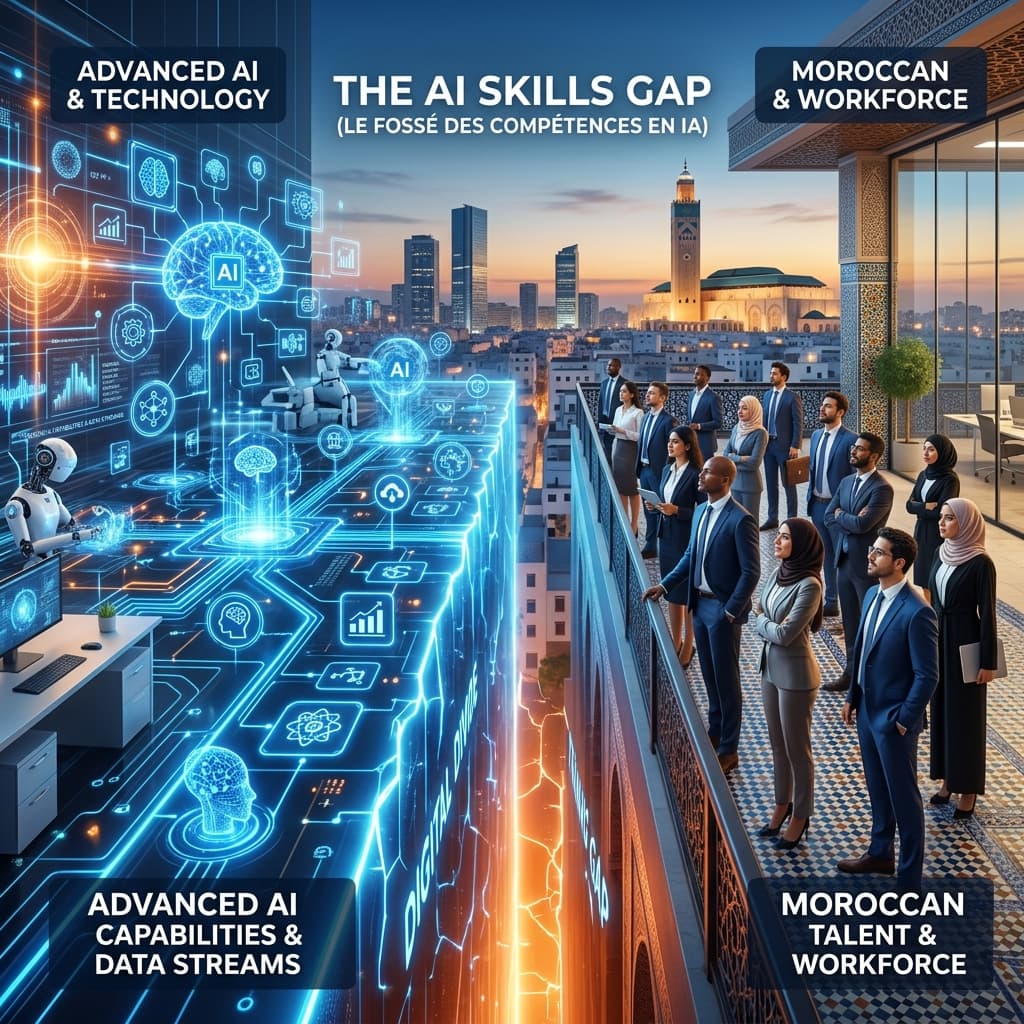
OECD microdata (July 2026) shows AI benefits productive regions first. For Morocco, this risks deepening territorial disparities. Scientific analysis, regional scenarios, and a strategic framework for business leaders.
1. Introduction: AI arrives, but for whom?
Artificial Intelligence (AI) promises to redefine global productivity. The World Bank (2026a) legitimately asks whether AI can reverse a structural slowdown in global potential growth and productivity. While the macroeconomic answer leans towards cautious optimism, a more urgent question arises at the local level: what does national productivity gain mean if it is spatially concentrated? In Morocco, where the Casablanca-Rabat axis already attracts the overwhelming majority of digital transformation investments, this question is highly strategic. Behind aggregate OECD productivity figures lies significant industry-level and spatial heterogeneity (OECD, 2026a). The promise of widespread automation could paradoxically widen the gap between already developed Moroccan regions and those struggling to capture the dividends of the digital revolution.
Selected clients, published with permission. More references will be added after approval.
As Morocco ranks 57th globally in the Huawei Digital Transformation Index for 2024 (IFC Africa, 2026), the challenge is no longer just whether Moroccan businesses will adopt AI, but *where* this adoption will create value. If the bulk of infrastructure, talent, and advanced use cases are concentrated in a handful of economic hubs, peripheral regions risk a double penalty: a loss of relative competitiveness and a brain drain towards digitized metropolises. Leaders must understand that AI automation Morocco is not a geographically neutral phenomenon.
2. What OECD microdata reveals about AI concentration
To anticipate the spatial impact of AI, examining firm-level dynamics is essential. Recent data shows that AI does not benefit all economic players equally. OECD microdata reveals that AI adoption is concentrated among already-productive firms, potentially reinforcing market concentration (OECD, 2026b). The highest-performing companies, which already possess optimized processes, structured data lakes, and significant investment capacity, are the first to deploy advanced machine learning algorithms to widen the gap with their competitors.
This microeconomic dynamic has major geographical implications. Although the OECD microdata does not directly include Morocco, the mechanism of concentration is analytically transferable. Highly productive firms tend to cluster in dense employment basins to benefit from agglomeration and spillover effects. Consequently, if AI strengthens the dominant position of already high-performing companies, it simultaneously enriches the regions where these corporate headquarters and innovation centers are located (OECD, 2026b). The risk is the emergence of "super-productivity hubs" surrounded by regions relegated to mere consumers of digital services.
3. The World Bank's question: Can AI reverse the structural slowdown?
The World Bank (2026a) asks whether AI can reverse a structural slowdown in global potential growth and productivity. Over recent decades, productivity growth has stalled in many emerging and advanced economies. Generative AI and advanced business automation are frequently presented as the catalysts capable of restarting this economic engine. However, the World Bank warns that the real impact will fundamentally depend on technology distribution and diffusion mechanisms within the economic fabric.
AI infrastructure attracted $341 billion in investment in 2025 alone, with semiconductors recording a 54% CAGR between 2020 and 2025 (UNCTAD, 2026). Nevertheless, these massive AI investment Africa inflows are highly polarized. While AI can theoretically boost Morocco's potential GDP growth, the inability to diffuse these technologies beyond central metropolises could severely limit macroeconomic gains. Policymakers and business leaders must ensure that AI does not become an "enclave technology," profiting only an elite group of export-oriented firms and financial services, without irrigating the rest of the Moroccan economy (World Bank, 2026a).
4. Aggregate productivity versus spatial reality: The blind spot
Analyzing national statistics often obscures a complex, fragmented reality. Behind the aggregate figures lies significant spatial heterogeneity (OECD, 2026a). A 2% increase in national regional productivity Morocco could perfectly result from a spectacular 15% gain in a Casablanca financial hub, hiding stagnation or even decline in other regions. This is the danger of relying solely on national averages for strategic planning.
The International Monetary Fund emphasizes that AI adoption in Sub-Saharan Africa could increase productivity between 0.2% and 2.1% depending on policy choices (IMF, 2026). However, this average conceals a latent spatial divergence AI risk. In Morocco, the historical GDP gap between the central axis (Casablanca-Rabat) and other regions is a well-known structural reality. AI-based automation, because it requires specific skills and digital infrastructures, acts as a powerful amplifier of these initial disparities. Ignoring the spatial dimension of productivity means steering national economic policy with a truncated indicator (OECD, 2026a).
5. The economic geography of Morocco facing AI
Morocco's current economic geography makes the country particularly vulnerable to AI-linked divergence. Currently, a disproportionate share of corporate headquarters, data centers, and technological talent pools (engineers, data scientists) is located along the Casablanca-Settat and Rabat-Salé-Kénitra axis. While Morocco's overall digital transformation Morocco ranking is 57th globally (IFC Africa, 2026), this national performance is heavily driven by this central macro-region.
If businesses continue to deploy their artificial intelligence and automation projects only where the ecosystem is most mature, digital investments will inevitably concentrate in these hyper-dense zones. Africa's digital economy growth is slow enough to be concerning (BCG, 2026), and spatial inequity worsens the picture. What happens to the industrial zones of Tangier or Fez, or agribusiness in Souss-Massa? An over-concentration of AI deployments in major Moroccan metropolises threatens to exacerbate a territorial imbalance that advanced regionalization plans are attempting to correct.
6. Talent, infrastructure, and capital: The three engines of divergence
Why do artificial intelligence investments tend to cluster geographically? The answer lies in the synergy of three fundamental engines: specialized talent, advanced digital infrastructures (like high-speed fiber networks and computing capacity), and access to investment capital. The OECD (2026b) notes that mastering complex digital technologies creates barriers to entry that only firms located in dense ecosystems can easily overcome.
Firms expect AI to lower employment by 1.3% cumulatively over the next 3 years (World Bank, 2026b), suggesting a substitution of routine tasks that demands high-level technical oversight. In Morocco, if Casablanca trains and retains the bulk of STEM graduates capable of managing this transition, businesses in less-endowed regions will struggle to implement their automation strategies. Venture capital (VC) funds and tech investments naturally gravitate towards areas where these three engines operate at full speed, creating a positive feedback loop for dominant hubs and a vicious cycle for the rest (OECD, 2026b).
7. Regional scenarios: What if the Casa-Rabat axis captures most AI gains?
Let us project into 2030. If the current trajectory of AI investment geography is maintained, a highly probable scenario given OECD (2026b) data patterns, the Casa-Rabat axis will capture the overwhelming majority of productivity gains linked to generative AI and cognitive automation. What will become of Morocco's other regional economic engines? In the Oriental region, logistics ambitions could stagnate against ultra-automated, AI-optimized port operations in other major global hubs.
In the Fès-Meknès region, the traditional manufacturing sector risks a critical loss of regional productivity Morocco, unable to compete with smart factories and predictive supply chains managed from the economic capital. Similarly, Souss-Massa's agribusiness could fall behind in operating margins if agricultural yield forecasting and cold-chain optimization tools remain the preserve of large, centralized conglomerates (World Bank, 2026a). This spatial divergence AI trend, if unmanaged, could nullify governmental efforts for territorial rebalancing.
8. The counter-scenario: Automation as a lever for decentralization
Fortunately, another path is possible. The very nature of cloud computing, modern automation platforms (such as API architectures and RPA), and SaaS AI tools offers a historic opportunity to reverse centralization. The share of firms adopting AI in OECD countries rose from roughly 7% in 2021 to roughly 20% in 2025, illustrating a rapid and increasingly accessible diffusion of advanced technologies (OECD, 2026c).
Business automation Maroc can become a formidable lever for economic decentralization. With reliable internet connections and subscription-based business models (Opex vs. Capex), a company based in Agadir or Oujda can now access the same large language models (LLMs) and workflow automation tools as a multinational in Casablanca. If Moroccan companies invest strategically in decentralized digital upskilling (regional reskilling) and leverage remote work for tech experts, they can create decentralized centers of excellence, distributing AI productivity gains more equitably (OECD, 2026c).
9. Implications for Moroccan business leaders
For Moroccan CEOs and boards of directors, these macroeconomic dynamics translate into immediate strategic decisions regarding site location, recruitment strategies, and the selection of automation vendors. Should all AI transformation initiatives be centralized at the Casablanca headquarters to maximize synergies and talent access, or should priority be given to automating the Tangier logistics warehouse or the Kenitra factory?
Companies adopting a geographically neutral approach risk encountering unforeseen bottlenecks (lack of local skills, adoption hindered by regional corporate culture). The optimal strategy (World Bank, 2026b) involves rigorously evaluating where automation can resolve critical local productivity deficits without relying exclusively on hyper-centralized physical infrastructures. Leaders must integrate the spatial variable into their AI investment business cases (OECD, 2026b).
10. Four-step strategic framework for territorially intelligent automation
To help businesses navigate this complexity, CoreMedia, as an AI agency Morocco specializing in digital transformation, has developed a four-step strategic framework designed specifically for multi-site Moroccan enterprises (CoreMedia methodology, grounded in OECD, 2026a evidence). This approach ensures that automation investments support balanced regional competitiveness:
1. **Map operational geography**: Identify value streams and productivity bottlenecks across all geographic sites of the company.
2. **Assess regional AI readiness**: Measure the digital maturity, connectivity, and cultural readiness of each site before any deployment.
3. **Sequence automation investments**: Prioritize decentralized use cases (e.g., regional procurement automation) before central functions.
4. **Distribute AI talent pipelines**: Create cross-training programs between central headquarters teams and regional employees to diffuse expertise.
11. Measurement, KPIs, and regionalized ROI
Deploying territorially intelligent automation requires rethinking performance indicators. A positive overall return on investment (ROI) can mask local value destruction. It is imperative to design metrics that capture the spatial distribution of gains, similar to the methodological approaches recommended for analyzing spatial heterogeneity (OECD, 2026a).
Companies must monitor productivity per employee by region, changes in processing times per site, and especially the retention rate of tech talent in peripheral areas. Tracking the time taken for adoption and ownership of new AI tools by site also makes it possible to quickly identify internal digital divides and deploy targeted change management plans. Data granularity is the keystone of this regionalized measurement (OECD, 2026a).
12. Limitations of the analysis and Morocco-specific data needs
It is important to highlight an inherent limitation in this macroeconomic analysis: the most detailed microdata on AI adoption currently comes from advanced economies (OECD, 2026b; World Bank, 2026a). The concentration dynamics observed in North American or European markets provide a powerful predictive model, but the Moroccan institutional context possesses its own singularities.
To refine these strategies, Morocco critically needs comprehensive primary firm-level data on local AI adoption, disaggregated by region and company size. Only localized empirical studies will make it possible to accurately measure the exact velocity of this regional divergence and the effectiveness of digital cohesion policies.
13. Conclusion: Act before the geography of AI solidifies
The economic geography of artificial intelligence is being written today. AI has the potential to revitalize global productivity (World Bank, 2026a), but the question of who will capture these gains remains open. Without deliberate strategic intent, economic gravity will naturally pull technological investments towards already dominant Moroccan hubs, risking an irreversible regional divide.
Moroccan business leaders have a unique opportunity to use AI automation Morocco not as a tool for centralized concentration, but as a formidable lever for distributed optimization. By adopting a territorially intelligent automation approach, they can turn the risk of divergence into a national competitive advantage.