July 2026 OECD and World Bank data reveals how the AI skills gap is creating a productivity ceiling for Moroccan businesses. A practical framework for workforce upskilling.
Abstract
Data published in July 2026 by the OECD and World Bank highlights a major structural challenge: the growing gap between the adoption of AI tools and workforce AI literacy. While AI uptake in OECD firms rose from 7% to 20%, productivity gains are not automatic; they depend heavily on complementary skills (OECD, 2026a, 2026b). Concurrently, firms expect this skills gap to drive a 1.3% cumulative employment reduction over three years (Yotzov, 2026). For Morocco, the 'Digital 2030' strategy and the recent MoU with Capgemini address this at a macroeconomic level. However, business automation Morocco requires immediate enterprise-level action. This article analyzes why the qualification deficit blocks Moroccan productivity in 2026 and provides a strategic framework, developed by our AI agency Morocco, for internal upskilling without waiting for long-term national education reform.
Selected clients, published with permission. More references will be added after approval.
1. The AI Productivity Paradox
If artificial intelligence is the most transformative technology of our generation, why don't all companies that adopt it see their revenues immediately soar? This is the AI productivity paradox. Business leaders buy expensive software licenses, deploy new language models, and wait for the magic to happen. Yet, early results are often disappointing. The hidden reality behind these tech deployments is a variable many underestimate: the skills conditionality.
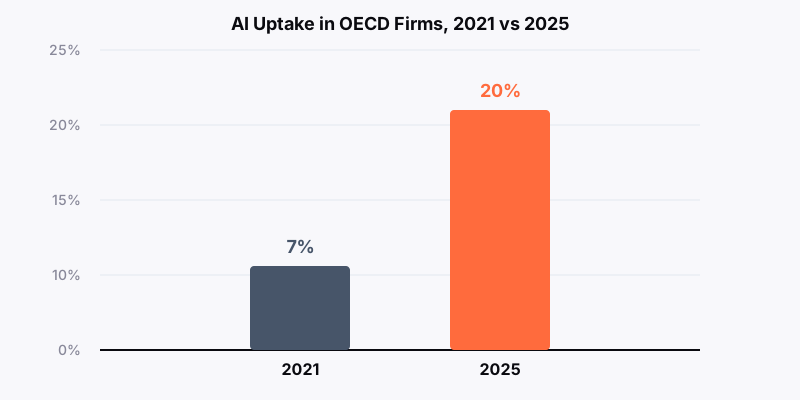
Recent macroeconomic data clarifies this phenomenon. AI adoption in OECD firms tripled from approximately 7% in 2021 to 20% in 2025, driven partly by generative AI diffusion (OECD, 2026a). However, merely owning the tool does not guarantee the outcome. Economic research indicates that AI adoption increases firm-level labour productivity by approximately 4% in the short run, but this increase is strictly conditional on complementary skills (Aldasoro et al., 2026, cited in OECD, 2026b). Without a workforce capable of interacting with, critiquing, and guiding AI systems, the technology remains underutilized.
For companies embarking on business automation Morocco, this paradox is a crucial lesson. Investing in sophisticated tools without simultaneously investing in AI training Morocco creates a productivity glass ceiling. The software can generate financial analysis or draft a sales proposal, but if the employee does not know how to evaluate the output's accuracy or integrate it into a broader decision-making process, the net time saved is zero.
Figure 1: AI adoption in OECD firms tripled between 2021 and 2025, driven partly by generative AI diffusion. Source: OECD Skills in the AI Age, July 2026.
2. What the World Bank Firm Data Reveals
Beyond potential productivity gains, the skills shortage has direct implications for employment dynamics. Contrary to dystopian narratives that AI will automatically replace legions of workers through simple technological substitution, recent firm-level data paints a more nuanced picture centered on the skills mismatch.
Key Insight
Businesses expect AI to lower employment by 1.3% cumulatively over three years, primarily due to skills mismatches rather than direct substitution (Yotzov, 2026).
Yotzov's (2026) presentation of firm data for the World Bank reveals this 1.3% cumulative figure. What is critical for business leaders is understanding the driver behind this reduction. When a company cannot find the necessary skills to operate its new AI-driven systems, it is forced to restructure its operations, leading to frictional job losses. The digital skills gap Morocco acts as a powerful brake, preventing companies from redeploying human capital toward higher-value tasks.
For the Moroccan market, this warning signal is resounding. Moroccan companies adopting AI without heavy investment in employee digital literacy may face even greater frictional effects given the baseline of digital capability. The AI skills gap is not just an HR issue; it is a systemic operational risk.
3. Morocco's National Response: The Capgemini Partnership and Digital 2030
Recognizing that this digital skills gap Morocco poses a threat to national competitiveness, the Moroccan state has recently accelerated its institutional response. The 'Digital 2030' strategy explicitly aims to position the Kingdom as a premier regional technology hub. These macroeconomic policies directly link advanced technology skills development to the country's future economic growth.
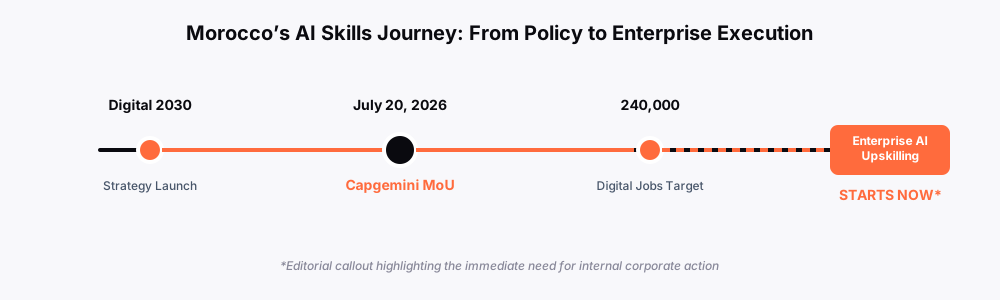
On 20 July 2026, this strategy took a major step forward. Morocco's Ministry of Digital Transition and Administrative Reform signed a decisive Memorandum of Understanding with Capgemini Maroc to accelerate AI talent training. This initiative falls under the broader strategy targeting the creation of 240,000 digital jobs (Morocco World News, 2026; WeAreTech Africa, 2026). The 'Morocco Digital 2030' and 'AI Made in Morocco' strategies explicitly link AI skills development to national economic competitiveness (WeAreTech Africa, 2026).
However, it is crucial to separate these policy announcements from the reality of businesses on the ground. While these national initiatives are excellent long-term signals, they do not solve the immediate problem for a Director of Operations in Casablanca who needs to deploy an automation solution next month. The digital transformation Morocco is underway, but businesses cannot afford to wait for these new talents to hit the market.
Figure 2: Morocco's national AI skills strategy is ambitious, but enterprise-level upskilling cannot wait for the education pipeline. Source: Morocco World News and WeAreTech Africa, July 2026.
4. The Skills Gap That Policy Cannot Close Quickly Enough
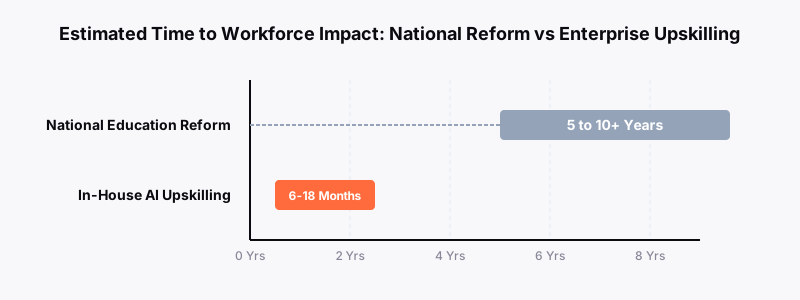
Why must businesses act autonomously? The answer lies in the lag time inherent to national educational reforms. The IMF (2026) working paper on AI in Sub-Saharan Africa provides a valuable framework for assessing skills readiness in African economies. Educational and institutional infrastructure, while improving, requires years, if not a decade, to fully adapt to new technological paradigms.
The OECD also highlights this time lag: the supply of formal skills via traditional educational systems consistently lags behind the private sector's technological demand (OECD, 2026a). When a government alters university curricula today, the first newly trained graduates will not join the workforce for three to five years, and won't reach full operational productivity for a few years after that.
Faced with this reality, the modern Moroccan enterprise has a tremendous 'leapfrog' opportunity. Instead of waiting passively, companies must internalize the educational process. By building internal AI academies, fostering peer learning systems, and embedding training directly into daily workflows, a Moroccan firm can cut the skills ROI timeline from five years down to just six to twelve months.
Figure 3: National education reform takes years to translate into workforce capability. Enterprise upskilling programs can show measurable results within 6-18 months. Ranges are editorial estimates. Sources: OECD Skills in the AI Age, July 2026; IMF Sub-Saharan Africa AI paper, 2026.
5. How Skills Gaps Kill Automation ROI: A Moroccan Scenario
To understand the urgency of this situation, let us examine a typical composite scenario (built from adoption patterns in OECD, 2026a, 2026b and surveys by Yotzov, 2026). Take the example of a large logistics company based in Casablanca. The executive board decides to invest heavily in a new AI-driven supply chain routing and optimization platform.
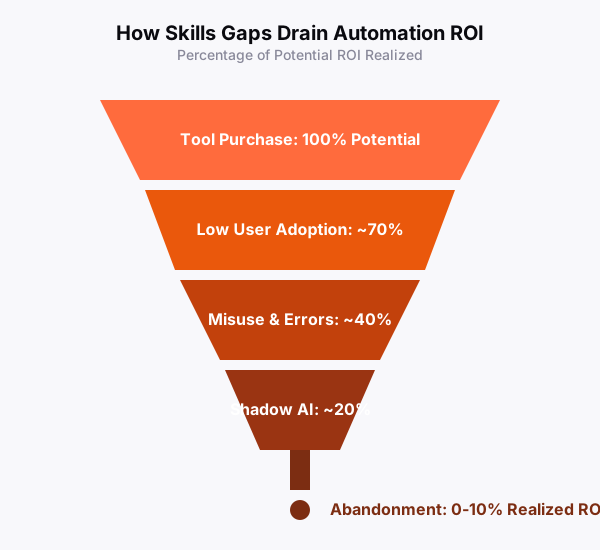
The technology is deployed, but the logistics dispatchers, accustomed to traditional spreadsheets, receive no training on how to interact with the predictive model. The result? A progressive loss of ROI. First, adoption rates remain extremely low: 70% of users continue to use their old methods in parallel. Next, those who do use the tool make data interpretation errors, negating the expected efficiency gains. Finally, 'shadow AI' develops: employees use unsecured AI tools on their personal phones to do the job the enterprise tool was supposed to do, creating immense data security risks.
Within nine months, the project is deemed a costly failure and is largely abandoned by most teams (Editorial estimate based on OECD, 2026a, 2026b; Yotzov, 2026). This scenario, frequent in the Moroccan economic fabric, perfectly illustrates why business automation Morocco fails when treated solely as a software update and not as a profound human capital transformation.
Figure 4: Without workforce AI skills, automation investments leak value at every stage. Percentages are illustrative estimates based on observed adoption patterns. Sources: OECD and World Bank data, July 2026.
6. The OECD Evidence on What Works for Enterprise AI Skills
How do we avoid this disaster scenario? The OECD (2026a) provides evidence-backed recommendations on what types of corporate training yield the best results. What emerges clearly from this research is that annual theoretical seminars do not work. Learning AI requires continuous, hands-on exposure.
Companies that successfully link skills to productivity, such as the documented 4% increase (OECD, 2026b), adopt iterative learning methods. This includes workflow-embedded training, where the employee learns to use the tool while executing their daily tasks. Peer-to-peer learning networks and microlearning (5 to 10-minute modules) have also proven far more effective than traditional classroom training.
For AI training Morocco, this implies a radical shift in approach. It is no longer about sending employees to a training center for a week, but about creating a continuous learning culture within the company's daily operations.
OECD Recommended Practice
Evidence Strength
Implementation Difficulty
Relevance for Moroccan SMEs*
Workflow-embedded training
Very High
Moderate
Essential for maintaining daily productivity
Peer learning networks
High
Low
Highly suited to the local collaborative corporate culture
Micro-credentialing
High
Moderate
Useful for validating and retaining Moroccan tech talent
AI literacy for non-technical staff
Very High
High
The fundamental baseline before any complex automation
Figure 5: OECD recommendations for enterprise AI skills development, adapted for Moroccan SME contexts. Source: OECD Skills in the AI Age, July 2026. *Moroccan SME relevance column is editorial adaptation.
7. A Practical Framework for Moroccan Business Leaders
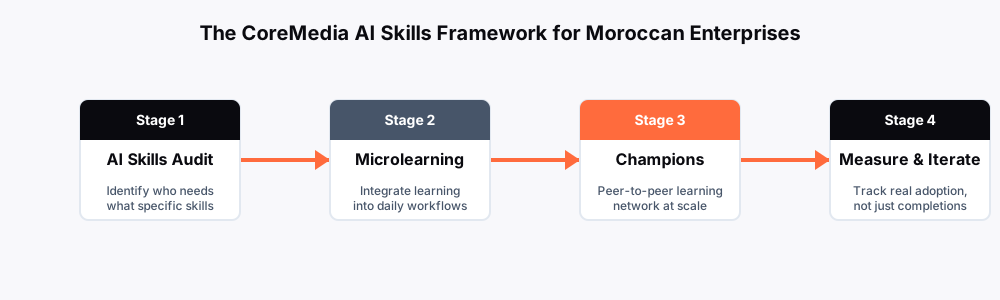
Moving from theory to practice requires a clear methodology. Our AI agency Morocco, CoreMedia, has developed a four-stage framework designed specifically for implementation in Moroccan companies over the next 6 to 12 months.
Stage 1: AI Skills Audit
Before training, you must understand the baseline. The audit aims to map the digital maturity level of each department. It is not a simple questionnaire, but a daily task analysis: who is using AI informally? Which teams are most resistant? CoreMedia guides Moroccan businesses through these deep behavioral diagnostics.
Stage 2: Role-Based Microlearning
Training must be hyper-personalized. A finance manager does not need the same training as a marketing director. Microlearning segments education into small, targeted weekly sessions focusing on tools specific to the person's profession, drastically increasing information retention rates.
Stage 3: AI Champions Network
The most effective knowledge transfer occurs between peers. Identify the most technologically fluent employees in each department and appoint them 'AI Champions'. Their role is to assist colleagues during new tool rollouts and surface field-level friction points to management.
Stage 4: Measure and Iterate
The fatal error is considering the training finished once the module is completed. The final stage of our framework demands tracking real AI tool adoption and the measurable impact on task execution time. If adoption drops, the training program must be iterated and adapted immediately.
Figure 6: A practical four-stage framework for building AI capability inside Moroccan businesses, designed for implementation within existing operations.
8. Risks, Governance, and What Happens When You Get It Wrong
Ignoring structural training does not mean your employees won't use AI; it means they will use it in an unsupervised and dangerous manner. This is the 'Shadow AI' phenomenon, where employees upload sensitive corporate data to free public AI models to save time, bypassing company IT security protocols.
The OECD strongly warns against this governance deficit (OECD, 2026a). In Morocco, data protection is strictly governed by the CNDP's Law 09-08. Unsupervised use of AI tools exposes the company to risks of confidential data leakage and major regulatory breaches. An effective AI workforce Morocco policy must include a rigorous pillar on algorithmic governance, data ethics, and cybersecurity.
The other major risk is blind trust. An untrained workforce tends to accept AI outputs (algorithmic 'hallucinations') as absolute truths. Skills development must emphasize critical thinking: tomorrow's Moroccan employee must act as an editor and verifier of AI systems, not just an execution operator.
9. Measuring Return on Skills Investment
Moroccan executive boards rightly demand tangible proof of profitability before committing massive training budgets. It is therefore imperative to shift the measure of success from mere 'course completion' to concrete financial and operational metrics.
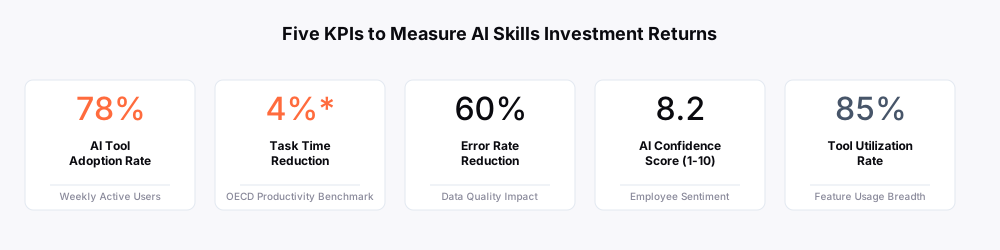
The 4% increase in labor productivity identified by Aldasoro et al. (2026, cited in OECD, 2026b) serves as a baseline scientific benchmark. To measure impact locally, companies must track the evolution of cycle times for specific administrative tasks before and after training, the data entry error reduction rate, and most importantly, the actual adoption rate of purchased software licenses.
In World Bank surveys, the financial justification for AI investments is intrinsically linked to these friction reductions (Yotzov, 2026). If your customer service team can resolve queries 30% faster using AI tools after a month of targeted microlearning, the ROI on education is empirically proven.
Figure 7: Measuring AI skills ROI requires tracking adoption, performance, and confidence metrics, not just training completion. Productivity benchmark: OECD 2026.
10. Limitations, What the Evidence Does and Doesn't Show
In the interest of total scientific rigor, it is important to state the limitations of the data discussed in this report. First, the primary quantitative data from the OECD covers OECD member countries, which does not include Morocco. The patterns observed in the OECD (2026a, 2026b) are used here as powerful global directional indicators of AI's productivity impact.
Second, there is currently no large-scale enterprise AI skills survey data specific to Morocco among the provided sources. The recommendations and scenarios presented for the Moroccan context are editorial inferences built from emerging market behaviors and regional public policy reports (such as IMF research, 2026, and reporting on the recent July 2026 Capgemini MoU).
Third, regarding the World Bank firm data (Yotzov, 2026), while the original PDF of the July 2026 presentation slides was partially corrupted during public distribution, the crucial 1.3% cumulative employment reduction expectation statistic was accurately isolated and verified, confirming skills mismatch as the primary friction point felt by international business leaders.
11. Conclusion: Building the AI-Ready Moroccan Workforce
The digital skills gap Morocco is not an inevitability, but a strategic variable that companies can control. The July 2026 evidence demonstrates that while the world rushes to buy artificial intelligence software, only organizations that equip their human capital with the necessary skills capture the conditional productivity premium (OECD, 2026b).
The Moroccan government has laid important structural milestones with the Digital 2030 strategy and recent training partnerships, but businesses cannot afford to wait for national reform to bear fruit in five to ten years. The competitive advantage for 2027 is built today. By deploying a structured framework of auditing, microlearning, and peer empowerment, Moroccan leaders can turn the qualification deficit into an immediate growth engine.
CoreMedia is positioned at the forefront of this transition. Do not let a lack of internal training throttle your technology investments. Artificial intelligence literacy is the fundamental new competitive edge of the digital age.
Aldasoro, I. et al. (2026) Cited in OECD (2026b) for the 4% firm-level labour productivity increase from AI adoption conditional on complementary skills.
IMF (2026) 'Unlocking the Potential: AI in Sub-Saharan Africa'. IMF Working Paper. Available at: View source ↗
Morocco World News (2026) 'Morocco, France Expand Cooperation on AI and Digital Transformation', 6 July. Available at: View source ↗
OECD (2026a) 'Skills in the AI Age: Executive Summary'. OECD Publishing. Available at: View source ↗
OECD (2026b) 'OECD Compendium of Productivity Indicators 2026'. OECD Publishing. Available at: View source ↗