2026 OECD, Harvard, and Gallup data reveals a measurable sales productivity gap. Moroccan sales teams that don't automate risk competitive disadvantage. Free diagnostic.
Abstract
AI adoption in sales teams is no longer mere experimentation; it is redrawing the baseline of competitiveness. This report examines fresh 2026 data from the OECD, Harvard, and Gallup, revealing a measurable productivity gap between firms that automate sales processes and those relying on traditional methods. With US organizational adoption jumping six percentage points in Q2 2026 and overall OECD firm adoption reaching 20% in 2025, the sales function emerges as one of the most highly exposed to AI productivity gains. For Moroccan business leaders, this widening divide means ignoring AI sales automation Morocco is no longer a viable strategy. CoreMedia synthesizes this international data and provides an exclusive sales AI maturity assessment framework to help Moroccan teams navigate this urgent transformation.
Selected clients, published with permission. More references will be added after approval.
1. Introduction: The New Sales Gap
Picture a Moroccan sales director arriving at the office on a Monday morning in July 2026. In a traditional firm, her team spends the first two hours manually inputting contact data into an outdated CRM, drafting generic outreach emails, and attempting to forecast end-of-quarter closes based largely on intuition rather than analytics. Meanwhile, at a competitor that has embraced AI sales automation Morocco, the commercial team starts their week with algorithmically prioritized lead lists, hyper-personalized email drafts ready for approval, and automated revenue forecasts generated from thousands of historical data points.
This divide is not science fiction; it is compounding before our eyes. The artificial intelligence sales productivity gap is actively restructuring the global competitive hierarchy. What we are witnessing in 2026 is the emergence of a stark dividing line between organizations that view AI as a novelty and those deeply integrating it into their enterprise revenue engine. Data from multiple authoritative sources converge to confirm this structural shift.
As a leading AI agency Morocco specialized in digital transformation, CoreMedia closely tracks these macroeconomic signals. Recent studies published in mid-2026 by premier institutions, including the OECD, Harvard University, Gallup, and the World Bank, quantify this phenomenon. This article dissects the new evidence and explores why sales productivity AI Morocco has become the critical lever that local teams can no longer afford to neglect.
2. What 2026 International Data Reveals
To grasp the magnitude of the disruption, we must examine the sheer velocity of AI uptake. Organizational AI adoption in U.S. workplaces experienced a spectacular jump of six percentage points in the second quarter of 2026 alone (Gallup, 2026). Such a sharp acceleration in a single quarter is historically exceptional for enterprise technology, outpacing early cloud computing or smartphone deployment rates.
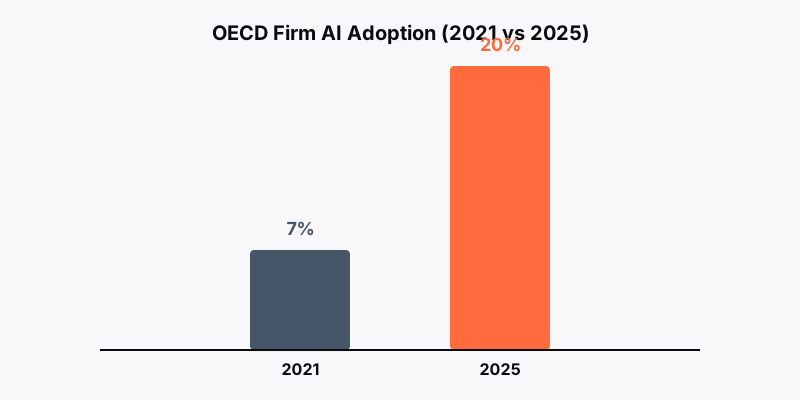
This momentum is not confined to the United States, though they lead the charge. AI adoption in OECD firms increased from approximately 7% in 2021 to 20% in 2025 (OECD, 2026a). This exponential growth proves that next-generation tools are transitioning from niche early-adopter experiments to the early majority phase. Simultaneously, executive expectations regarding business automation Morocco and overall efficiency are extremely high: 64% of surveyed businesses believe AI will improve their business productivity, while 42% believe it will significantly streamline job processes (Forbes Advisor, 2026).
However, these productivity expectations are paired with measured projections on employment. World Bank firm-level survey data indicates that businesses expect AI to lower employment by 1.3% cumulatively over a three-year period, while substantially raising overall productivity (Yotzov, 2026). This suggests that the true power of sales AI lies not in mass commercial replacement, but in radically increasing the revenue yield per employee.
Figure 1: The proportion of OECD firms adopting AI rose from approximately 7% in 2021 to 20% in 2025, driven by the diffusion of generative AI. Source: OECD (2026a).
3. The Sales Function Exposed
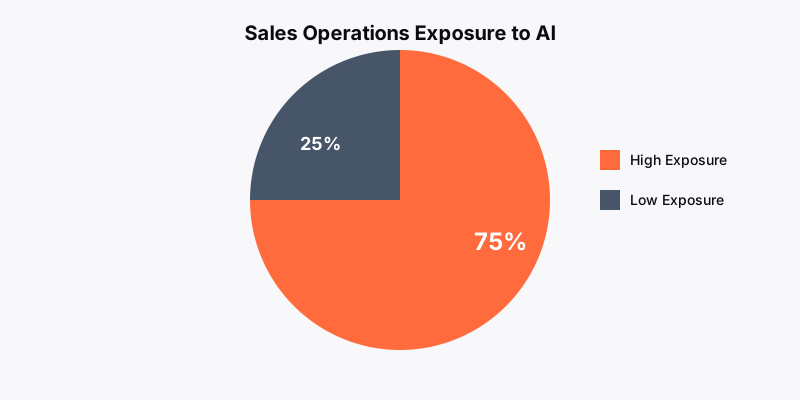
Not all business functions are equally impacted. A rigorous sectoral analysis conducted by the Harvard Kennedy School MRCBG (2026) specifically identifies sales and customer-facing functions as being among the most highly exposed to labor transformation driven by agentic AI and digital augmentation.
Why is the sales function so heavily exposed? Because the modern sales process is fundamentally an asymmetric exercise in information processing, classification, and communication. Historically, a sales representative spent a fraction of their time actually selling, with the bulk of their day swallowed by administrative friction. Today, AI sales automation targets these exact administrative bottlenecks. Lead scoring is handled by predictive models. Proposal generation is automated. CRM data entry is performed via automatic transcription and semantic analysis of client calls.
For firms that invest, this liberates a massive number of hours. Workflow automation allows sales professionals to focus exclusively on empathy, strategic negotiation, and relationship building, complex human skills that AI does not yet possess. It is precisely this reallocation of time toward high-value tasks that drives the productivity gap.
Figure 2: Sales and customer-facing functions are among the most exposed to AI transformation, according to Harvard Kennedy School MRCBG (2026) analysis. Illustrative synthesis.
4. Documented Productivity Gains
What are the tangible outcomes of this time reallocation? The most recent data provides clear evidence of the gains. The highest self-reported AI productivity gains are concentrated in coding and automation-intensive tasks, heavily including sales automation (Gallup, 2026). These empirical observations are beginning to form a consensus regarding the profitability of commercial AI investments.
At the macroeconomic level, the potential impact of AI on the global labor market and productivity is being assessed by major financial institutions. Goldman Sachs (2026) anticipates that generative AI could significantly boost global labor productivity over the next decade, with administrative and commercial functions on the front lines to capture these efficiencies. Furthermore, funding for AI workflow automation surged from $381 million in 2024 to approximately $1.14 billion in 2025 (NewMarketPitch, 2026), signaling overwhelming institutional investor confidence in the ROI of these B2B software solutions.
It is worth noting the current lack of specific, large-scale randomized studies for Morocco. Nevertheless, international data serves as powerful directional evidence. The underlying mechanisms, freeing up administrative time, better lead qualification, and accelerating sales cycles, are universal and apply directly to the Moroccan market. A sales representative in Casablanca spending two hours a day manually updating CRM statuses suffers the exact same efficiency loss as a rep in Paris or New York.
5. Productivity Gap or Competitiveness Gap?
Increasing productivity within a single sales team is excellent. But when broad segments of the economy adopt AI at disparate rates, sales productivity AI Morocco transforms into a structural competitiveness gap. OECD analyses document strong heterogeneity at the industry level (OECD, 2026b), suggesting that 'superstar' firms are pulling further and further away from the rest of the pack.
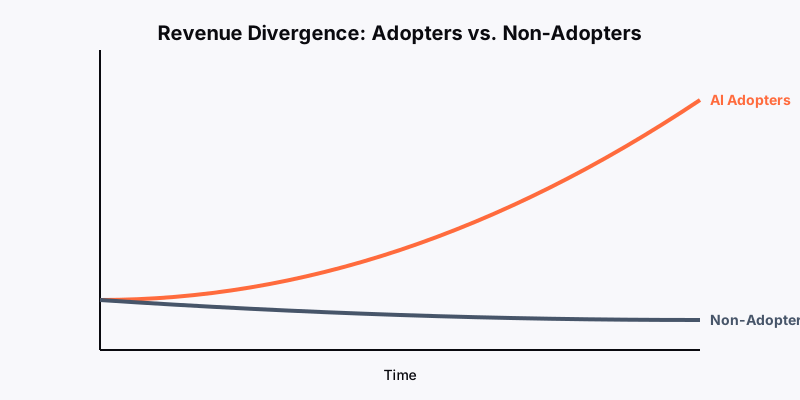
The productivity divergence analyzed by the OECD (2026a) explains this compounding mechanism. Total estimated AI investments in the United States are more than twice that of all other OECD countries combined in 2025 (OECD, 2026a, Figure 3 Panel B). This massive investment imbalance creates a positive feedback loop: companies that invest generate more revenue, enabling them to accumulate more data to train better predictive models, which in turn generates even more revenue. Over a three-to-five-year horizon, what began as a slight advantage in lead response times snowballs into insurmountable market share dominance.
For the Moroccan economy, this divergence logic applies perfectly to the local competitive landscape. Companies operating in Morocco (whether multinationals or forward-thinking local SMEs) that integrate these tools will begin to systematically outperform their traditional counterparts in B2B customer acquisition.
Figure 3: Illustrative scenario constructed from productivity divergence patterns documented by OECD (2026a). Does not represent actual Moroccan company data.
6. The Moroccan Context: Opportunity and Urgency
How does AI sales automation Morocco fit into the national economic context? According to CoreMedia's experience with Moroccan clients, the local economic fabric presents a mix of accelerated digitalization among end consumers and often fragmented IT infrastructure on the enterprise side. The digital transformation Morocco is advancing rapidly, yet sales data and CRM systems often lack the cleanliness required for complex, native AI deployments.
However, this is paradoxically where the major opportunity lies. Unlike saturated North American markets, Moroccan companies can leverage AI automation to 'leapfrog' an entire generation of complex traditional software. A Moroccan SME does not need to endure years of slow software transitions; it can jump directly from local Excel files to an AI-augmented cloud ecosystem.
The Moroccan B2B market is particularly highly responsive to follow-up speed. An AI CRM automation Morocco capable of qualifying a prospect on WhatsApp at midnight and automatically scheduling a meeting with the appropriate sales rep for the next morning offers a colossal competitive advantage in an ecosystem where average response times are often measured in days.
7. Scenarios for a Moroccan Sales Director
Faced with this data, where should one begin? CoreMedia has synthesized international best practices into three actionable maturity levels for the local context. These scenarios do not aim to 'replace' sales staff, but to deploy an intelligent CRM that amplifies their capabilities.
The first level (Fundamental) focuses on unifying communications. This is the integration of a cloud-based CRM coupled with the WhatsApp Business API, allowing for centralized exchanges and eliminating information silos. This is the starting point for any business automation Morocco.
The second level (Intermediate) introduces predictive intelligence. AI analyzes past behaviors to assign scores to leads (predictive scoring), automating low-value follow-up emails while flagging ripe opportunities for human reps.
The third level (Advanced) represents total maturity: the deployment of an agentic platform. The AI no longer merely predicts; it executes multi-channel orchestration workflows, manages preliminary first-level negotiations, and dynamically updates real-time financial forecasts without human intervention.
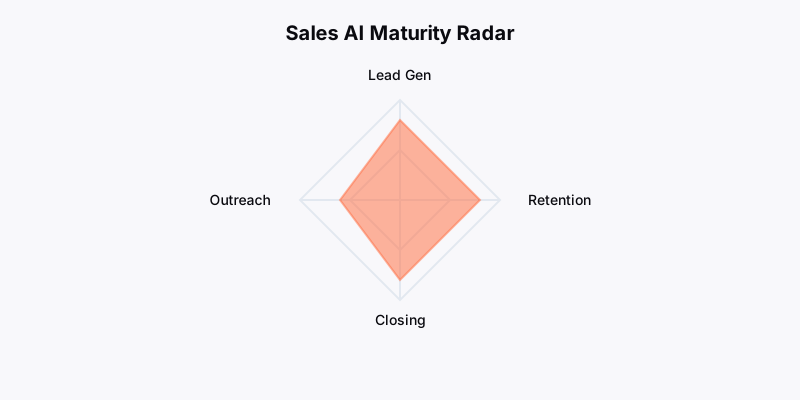
To evaluate your readiness, CoreMedia offers a self-assessment tool based on five crucial dimensions. Before investing heavily in new software, every sales director should plot their team on this axis.
1. Data Readiness: Is your prospect data stored in local silos or centralized in a cloud system accessible via API?
2. Process Standardization: Does your sales cycle follow clear, documented, and repeatable stages?
3. Tooling: How modern is your current technological stack?
4. Team Skills: Does your team possess the digital agility required to interact with analytical tools?
5. Leadership Commitment: Does top management financially and culturally support the adoption of automation?
Figure 4: Five-dimension self-assessment framework for Moroccan sales teams. CoreMedia (2026) original framework.
9. Risks, Governance, and Pitfalls
The adoption of commercial AI is not without risks. The most frequent pitfall is asymmetric deployment: purchasing a highly expensive AI tool without first cleaning the databases (the 'garbage in, garbage out' principle). AI systems can only amplify what they are fed; if a sales process is broken or chaotic, AI will merely accelerate that chaos.
In terms of governance, data protection is paramount. In the Moroccan context, this implies rigorous compliance with Law 09-08 regarding the protection of individuals concerning the processing of personal data (CNDP). Intelligent CRM tools, particularly those leveraging external Large Language Models (LLMs), must be configured to ensure that proprietary Moroccan client data is not used to train public AI models. These privacy principles echo the Preliminary Report of the UN Independent International Scientific Panel on AI (2026), which emphasizes equitable and secure enterprise algorithm governance.
10. Measuring Return on Investment (ROI)
The success of marketing automation Maroc must be quantified. Too many digital initiatives fail because they do not link technological integration to key financial metrics. To prove efficacy, sales directors must establish a solid baseline prior to any implementation.
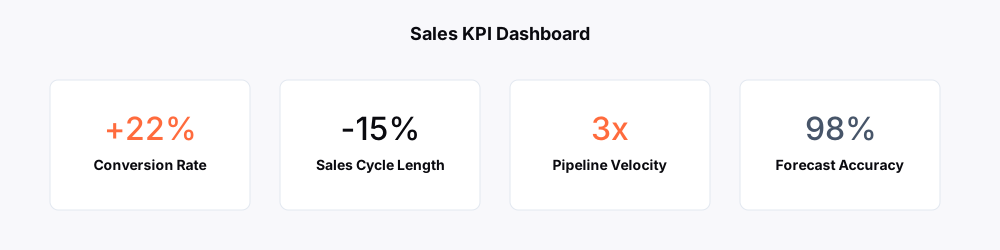
Crucial KPIs include lead response time (critical for B2B), pipeline velocity (the number of days needed to move a lead from discovery to close), overall win rate, and cost per qualified lead. AI has a measurable impact on each of these factors by eliminating time-consuming tasks and accurately scoring prospect quality.
Figure 5: Illustrative before/after automation comparison. Values are indicative and vary by sector and adoption level.
11. Limitations of the Analysis
In the interest of transparency, as an AI consulting Morocco agency focused on scientific rigor, CoreMedia highlights that this synthesis relies heavily on macroeconomic aggregations and Western international reports (OECD, Gallup, Harvard). Currently, there are no large-scale randomized controlled trials exclusively examining AI adoption in Moroccan sales in 2026.
Furthermore, while Forbes (2026) and Gallup (2026) data indicate spectacular increases in expectations regarding adoption and efficiency, the exact causal impact of AI on revenue growth isolated from other market conditions remains complex to measure. The prospective financial figures presented in this article should be interpreted as directional illustrative scenarios, not as absolute financial outcome guarantees.
12. Conclusion and Call to Action
The sales productivity gap is widening. With the OECD firm adoption rate reaching 20% (OECD, 2026a) and sales functions consistently identified as the most exposed to efficiency gains (Harvard MRCBG, 2026), the mandate for Moroccan leaders is clear. The question is no longer whether AI will transform the sales cycle, but what position your company will occupy when the digital divide solidifies.
For now, Moroccan businesses have an invaluable window of opportunity to act proactively. CoreMedia, your trusted AI agency Morocco, is strategically positioned to guide you through this technological shift. Assess your team's maturity, identify your most costly processes, and deploy targeted automations.
Anthropic (2026) 'The Anthropic Economic Index'. Available at: View source ↗
Forbes Advisor (2026) '22 Top AI Statistics & Trends'. Available at: View source ↗
Fortune Business Insights (2026) 'Generative AI Market Size, Share, Value Report [2026-2034]'. Available at: View source ↗
Gallup (2026) 'Organizational AI Adoption Jumps Six Points'. Gallup Workplace. Available at: View source ↗
Goldman Sachs (2026) 'How Will AI Impact the Labor Market?' Goldman Sachs Exchanges. Available at: View source ↗
Harvard Kennedy School MRCBG (2026) 'Future of Work in the Age of Automation, Augmentation, and Agentic AI'. Harvard University. Available at: View source ↗
OECD (2026b) 'OECD Compendium of Productivity Indicators 2026'. OECD Publishing. Available at: View source ↗
ResearchGate (2026) 'Artificial intelligence in digital marketing automation: Enhancing personalization, predictive analytics, and ethical integration'. Available at: View source ↗
UN Independent International Scientific Panel on AI (2026) 'Preliminary Report'. Available at: View source ↗
Yotzov, I. (2026) 'Firm Data on AI'. World Bank Presentation. Available at: View source ↗