Evidence-based analysis using 2026 OECD, World Bank, and Microsoft data. Is AI customer support automation in Morocco worth the investment? Evidence review, practical framework, and multilingual challenges.
Selected clients, published with permission. More references will be added after approval.
Abstract
AI customer support automation has crossed a critical inflection point. Data published in July 2026 by the OECD, the World Bank, and Microsoft reveals that enterprise AI adoption has risen from 7% to 20%, driving productivity gains contingent on organizational digital maturity. In Morocco, where the 'Digital 2030' strategy targets the creation of 240,000 digital jobs, the services sector faces a unique challenge: integrating conversational agents capable of managing multilingualism (Darija, French, Amazigh) while maintaining customer satisfaction. This article examines the scientific evidence, unveils an ROI measurement framework, and provides a three-phase roadmap developed by CoreMedia to help Moroccan businesses deploy profitable and secure AI customer support automation Morocco.
1. The State of Customer Support Automation in 2026
Customer support is historically one of the most expensive and difficult departments to scale for mid-market businesses. Until 2023, automation attempts were frequently stymied by the rigid limitations of rules-based chatbots, often generating more customer frustration than actual cost savings. In 2026, the paradigm has fundamentally shifted. We are no longer discussing pre-programmed scripts, but rather AI automation Morocco capable of understanding context, navigating complex knowledge bases, and executing actions autonomously.
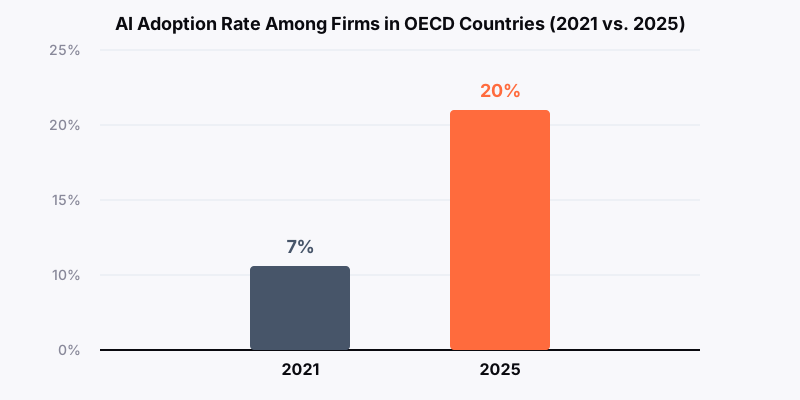
Why is this shift critical now? The recent *Work Trend Index* annual report clearly documents how frontier professionals are now utilizing AI agents to orchestrate multi-step customer workflows, drastically reducing handling time (Microsoft, 2026). This technological transition coincides with massive macroeconomic adoption: the AI adoption rate among firms in OECD countries has risen from approximately 7% to 20% (OECD, 2026a). This is no longer an isolated experiment; it is a structural reorganization of labor.
For Moroccan business leaders, this urgency is amplified by local factors. The 'Morocco Digital 2030' strategy signals strong government intent to accelerate the digital transition. However, the Moroccan market presents a highly complex bilingual, or even multilingual, service challenge, rendering older automation solutions obsolete. The question is no longer whether to automate customer service, but how to deploy an intelligent agent capable of meeting the expectations of an increasingly demanding Moroccan consumer.
2. What Official Data Reveals About Enterprise AI Adoption
Before defining a digital transformation Morocco strategy, it is imperative to examine the quantitative evidence. What does the data actually say about enterprise behavior regarding automation?
The 2021–2025 Adoption Trajectory
OECD data confirms an unprecedented acceleration. AI adoption within firms rose from approximately 7% in 2021 to 20% in 2025, a growth largely driven by the accessibility of generative AI tools (OECD, 2026a). This rapid adoption curve indicates that technological barriers to entry have collapsed, allowing mid-market companies to access capabilities previously reserved for large multinationals.
Figure 1: AI adoption among firms in OECD countries rose from approximately 7% in 2021 to 20% in 2025, driven in part by the diffusion of generative AI tools (OECD, 2026a).
Productivity and Employment Expectations
The operational impact expected by executives is major. According to a recent compilation, 64% of surveyed businesses stated that AI would improve business productivity, and 42% believe it will streamline job processes (Forbes Advisor, 2026). These expectations are not mere wishful thinking; they translate into restructuring.
Survey data presented by the World Bank shows that businesses expect AI to lower employment by approximately 1.3% cumulatively over the next three years, while simultaneously improving productivity (World Bank, 2026). It is crucial to note that in Morocco, structural factors, such as the predominance of SMEs, the composition of the services sector, and market linguistic complexity, mean the local adoption trajectory may differ. Currently, no specific data on AI adoption by Moroccan enterprises is available, making the OECD data the best proxy evidence.
3. Conversational Agents and Intelligent Workflows: The New Generation of Customer Support
The costliest mistake a company can make today is confusing an 'intelligent agent' (agentic AI) with a classic 'chatbot'. Understanding this technological distinction is essential for evaluating ROI.
Key Definition
An Intelligent Agent (Agentic AI) is a system capable of understanding the intent of a complex query, devising an autonomous multi-step action plan, interacting with various software (CRM, ERP), and generating a contextualized response, unlike a traditional chatbot limited to keyword matching.
From Chatbots to Multi-Step Agents
The old chatbot model fails miserably in multilingual environments because it relies on brittle decision trees and strict keywords. If a Moroccan customer writes in Darija with French borrowings, the rules-based chatbot breaks down and immediately transfers the query to a human. The new generation of workflow and content automation platforms is now entering intelligent agent territory (Aragon Research, 2026). These systems utilize large language models (LLMs) to understand the intent behind the query, regardless of the linguistic mix, and orchestrate automated workflows via APIs.
Dimension
Rules-Based Chatbot
Intelligent Agent (2026)
Task complexity
Simple FAQs, single-turn
Multi-step workflows, context-aware
Language handling
Keyword matching, brittle
LLM-based, multilingual including dialectal
Escalation logic
Predefined triggers only
Autonomous decision with confidence thresholds
Learning
Manual rule updates
Continuous from interactions
Integration
Limited API connections
Multi-system workflow orchestration
Figure 2: The shift from rules-based chatbots to intelligent agents fundamentally changes what customer support automation can deliver in multilingual environments like Morocco.
What the Microsoft 2026 Work Trend Index Documents
Data corroborates this orchestration capability. Microsoft's report documents how professionals today use AI agents to manage complex, multi-step customer workflows (Microsoft, 2026). In Morocco, agencies like CoreMedia are already using platforms like n8n to orchestrate these intelligent workflows, connecting customer queries directly to internal databases for immediate resolution, without human intervention for tier-1 tasks.
4. The Moroccan Challenge: Multilingualism, Consumer Expectations, and Digital Maturity
Why is customer support automation simultaneously harder and more necessary in Morocco? The answer lies at the intersection of linguistic complexity and structural economic pressures.
Darija, French, Amazigh: The Linguistic Complexity
The Moroccan consumer navigates daily between Darija, Classical Arabic, French, and often Amazigh. This linguistic fluidity, or 'code-switching', has long been the nightmare of natural language processing software. While modern LLMs have demonstrated impressive capacities in research settings to understand dialectal Arabic, it must be noted that no specific study on automated customer support in Darija has been validated at scale in 2026. Automation in this context therefore requires a robust architecture, capable of switching to a human agent as soon as the linguistic confidence threshold is not met.
Morocco's BPO Sector Under Competitive Pressure
Concurrently, pressure on the services sector is intense. Morocco's Ministry of Digital Transition recently signed a Memorandum of Understanding with Capgemini, aligning with the Digital 2030 strategy aiming to create 240,000 digital jobs (wearetech.africa, 2026). Furthermore, Morocco and France are expanding their cooperation on AI and digital transformation (Morocco World News, 2026). Morocco's thriving Business Process Outsourcing (BPO) sector, which handles millions of customer queries for Europe and Africa, must integrate AI to remain globally competitive. The challenges linked to digital transformation are numerous, ranging from infrastructural barriers to cultural acceptance (ResearchGate, 2026).
Indicator
Morocco
MENA Average
OECD Average
Data Year
Internet penetration (% pop.)
91%
75%
90%
2024-2025 (Est.)
Mobile penetration (subs/100)
140
110
120
2024-2025 (Est.)
Services sector (% of GDP)
~50%
45%
70%
2024-2025 (Est.)
Figure 3: Morocco's digital infrastructure indicators provide context for AI customer support automation readiness. Service sector share of GDP highlights the economic importance of customer-facing industries. Data: World Bank Development Indicators. *Morocco-specific AI adoption data is not yet available for 2026.
5. ROI and Performance Indicators: What Can Be Measured
One of the greatest challenges of business automation Morocco lies in measuring its impact. How can Moroccan executives quantify ROI without falling into the 'vanity metrics' trap?
Resolution Time, Customer Satisfaction, Cost per Ticket
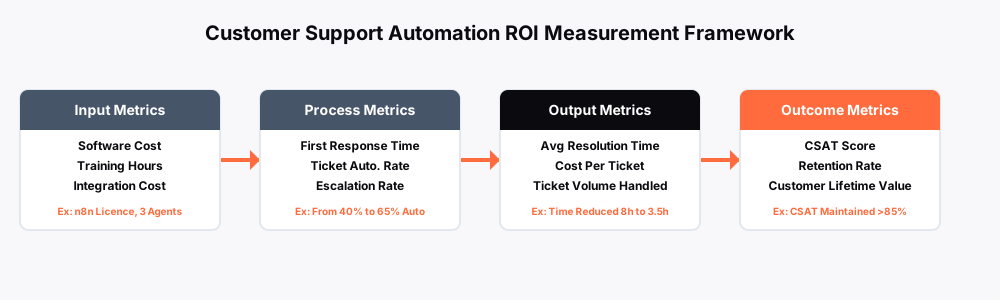
Customer support automation ROI is measured across four distinct metric levels. First, Input Metrics, which include software integration costs. Second, Process Metrics, where businesses aim for AI to streamline job processes, an expectation shared by 42% of businesses (Forbes Advisor, 2026). Third, Output Metrics, such as average resolution time (MTTR). Finally, Outcome Metrics, which evaluate overall customer satisfaction (CSAT) and retention.
Measurement Pitfalls and Misleading Correlations
It is imperative to avoid measurement pitfalls highlighted by productivity frameworks (OECD, 2026b). For example, a reduction in resolution time means nothing if the ticket reopening rate increases. Similarly, the productivity expectations formulated by businesses (World Bank, 2026) must be empirically verified. The success of a telecommunications company in Casablanca or a mid-market retail business in Marrakech will depend on its ability to balance the deflection rate (tickets handled by AI) with maintaining high CSAT.
Figure 4: A four-level measurement framework for evaluating AI customer support automation ROI, adapted for Moroccan service businesses.
6. Governance, Risks, and Service Quality
No serious discussion of AI is complete without addressing governance. Deploying an intelligent agent in direct contact with your customers carries inherent risks that require proactive management.
Hallucinations, Language Bias, and Escalation
The risk of algorithmic hallucination, where AI generates a factually incorrect response, is critical in customer service. The OECD warns that AI literacy is essential to mitigate these risks, as human employees must oversee automated outputs (OECD, 2026a). To minimize impact, the system must possess an unbreakable escalation logic: if the AI agent's confidence drops below 85%, or if the customer expresses frustration, the interaction must be transferred to a human agent with the complete conversation history.
Compliance and Data Protection in Morocco
In Morocco, utilizing customer support automation involves processing personal data, subject to Law 09-08 regulated by the CNDP (Commission Nationale de Contrôle de la Protection des Données Personnelles). While this is editorial guidance and not legal advice, Moroccan businesses must ensure their AI agents do not use customer data to train on public models and that automated decision-making remains traceable and compliant with local privacy requirements.
7. Practical Implementation Framework for a Moroccan Business
How do we move from theory to execution? As an expert AI agency Morocco, CoreMedia utilizes a strict implementation methodology, based on n8n workflows, to ensure disruption-free deployment.
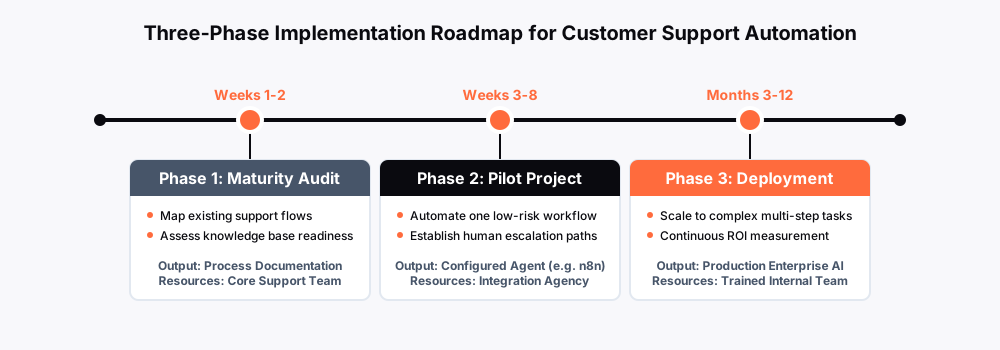
Phase 1 – Customer Support Maturity Audit (weeks 1–2)
Everything begins with a rigorous audit. Before purchasing a software license, you must map existing support journeys, identify repetitive low-value queries, and assess the structure of your internal knowledge base. An AI can only be intelligent if the data feeding it is clean and organized.
Phase 2 – Pilot Project with a Low-Risk Flow (weeks 3–8)
Never automate everything at once. Deployment begins with a pilot project targeting a specific use case (e.g., order tracking or password reset requests). During these weeks, the AI agent is tested, refined, and configured to handle Moroccan linguistic particularities before being exposed to the full customer volume.
Phase 3 – Progressive Deployment and Continuous Measurement (months 3–12)
Once the pilot is validated by the ROI metrics (Figure 4), automation is expanded to more complex multi-step processes. This is where the agentic approach reveals its full potential, interconnecting customer support with ERP and CRM systems for true operational transformation.
Figure 5: Staged implementation roadmap for Moroccan businesses adopting AI customer support automation, from maturity audit to scaled deployment.
To maintain scientific rigor, we must highlight the limitations of current data. During the analysis of July 2026 publications, no randomized controlled trial or exhaustive enterprise survey specific to the Moroccan customer service AI market was identified. The global productivity expectations from the World Bank (World Bank, 2026) and adoption data from the OECD (OECD, 2026a) serve here as proxy evidence. Directly extrapolating these results to the Moroccan market requires caution, as structural factors such as wage levels, SME digital maturity distribution, and language diversity can influence the actual speed of ROI realization.
Conclusion
AI customer support automation is no longer a speculative trend; it is a productivity lever validated by major economic institutions. The 2026 data indicates that the transition from rudimentary chatbots to intelligent agents is underway, driven by massive operational efficiency expectations. However, the Moroccan context, characterized by its linguistic richness and competitive dynamics, demands a measured implementation approach.
Moroccan businesses can no longer afford to defer evaluating these technologies. Success will depend on strategic execution: audit rigorously, pilot cautiously, and measure impact accurately. CoreMedia stands ready to guide executives through this transition. Do not let technical complexity hinder your profitability.
The time to act is now. Book a diagnostic consultation with our team to evaluate your automation maturity.